

(Published in the Dispatch)
Inflation-weary voters are now watching gas prices spike from $2.80 to nearly $4 per gallon, an increase expected to drain hundreds of dollars from the pockets of typical families if they persist for a year or longer. Rising prices and a global economic slowdown are also reviving recession fears. And yet these costs are entirely policy-driven and preventable—the result of President Donald Trump’s decision to attack Iran without first securing oil and liquified natural gas (LNG) shipping through the Strait of Hormuz.
Once again, political leaders are asking voters to accept higher prices as the necessary cost of some other policy goal.
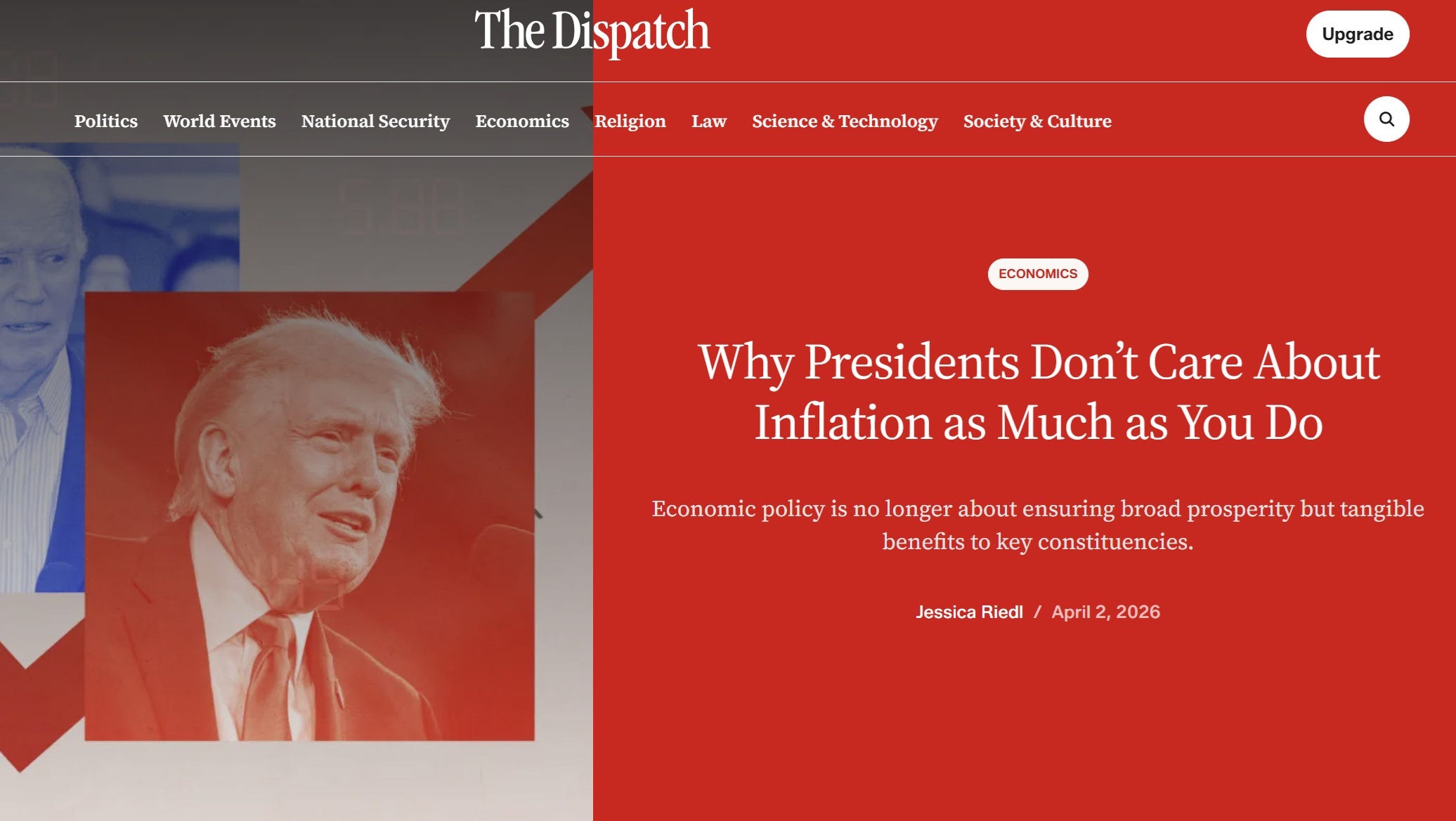
For the past four years, inflation has consistently polled as voters’ top economic concern—and often top concern overall. Nevertheless, President Joe Biden steadfastly ignored those concerns and pursued an inflationary agenda until it cost his party the White House. Then, after Trump campaigned on ending “Bidenflation,” he re-entered the White House and immediately unleashed his own aggressively inflationary agenda—tariffs, tax cuts, spending expansions, immigration deportations, and demands for Federal Reserve rate cuts. His approval rating has accordingly plummeted to 29 percent on the economy and 23 percent on inflation and prices. The likely result will be Republicans losing the House, and possibly even the Senate, in November.
Politically, this seems inexplicable. If inflation is the top voter concern—and at this point the leading determinant of presidential approval ratings and election outcomes—why do presidents keep ignoring the public will and pursuing inflationary policies? Don’t politicians care about inflation as much as we do? Don’t they desire the popularity that comes with addressing what voters care about most?
The answer is that Washington economic policy is no longer primarily about securing broad prosperity, low unemployment, and restrained inflation. Rather, it is about delivering targeted benefits to specific key constituencies. Presidents want to lavish their coalition with tax cuts, spending expansions, protection from foreign competition, and regulatory favors. Such benefits are tangible and traceable directly back to the president.
And the economists’ warnings? While debating new policy proposals, any resulting inflation or recession feels like a theoretical possibility rather than a predictable outcome. Maybe tariffs will raise prices—but what if they don’t? Who can say with certainty that a tax cut and spending spree will truly ignite inflation? Or that Federal Reserve rate cuts will do the same? After all, expert warnings of inflation following President Barack Obama’s 2009 stimulus and the Fed’s expansionary policies never materialized. And there is always some economist or organization willing to argue that a given president’s agenda carries no meaningful macroeconomic downside. So why sacrifice tangible benefits for a theoretical risk of broad economic harm?