

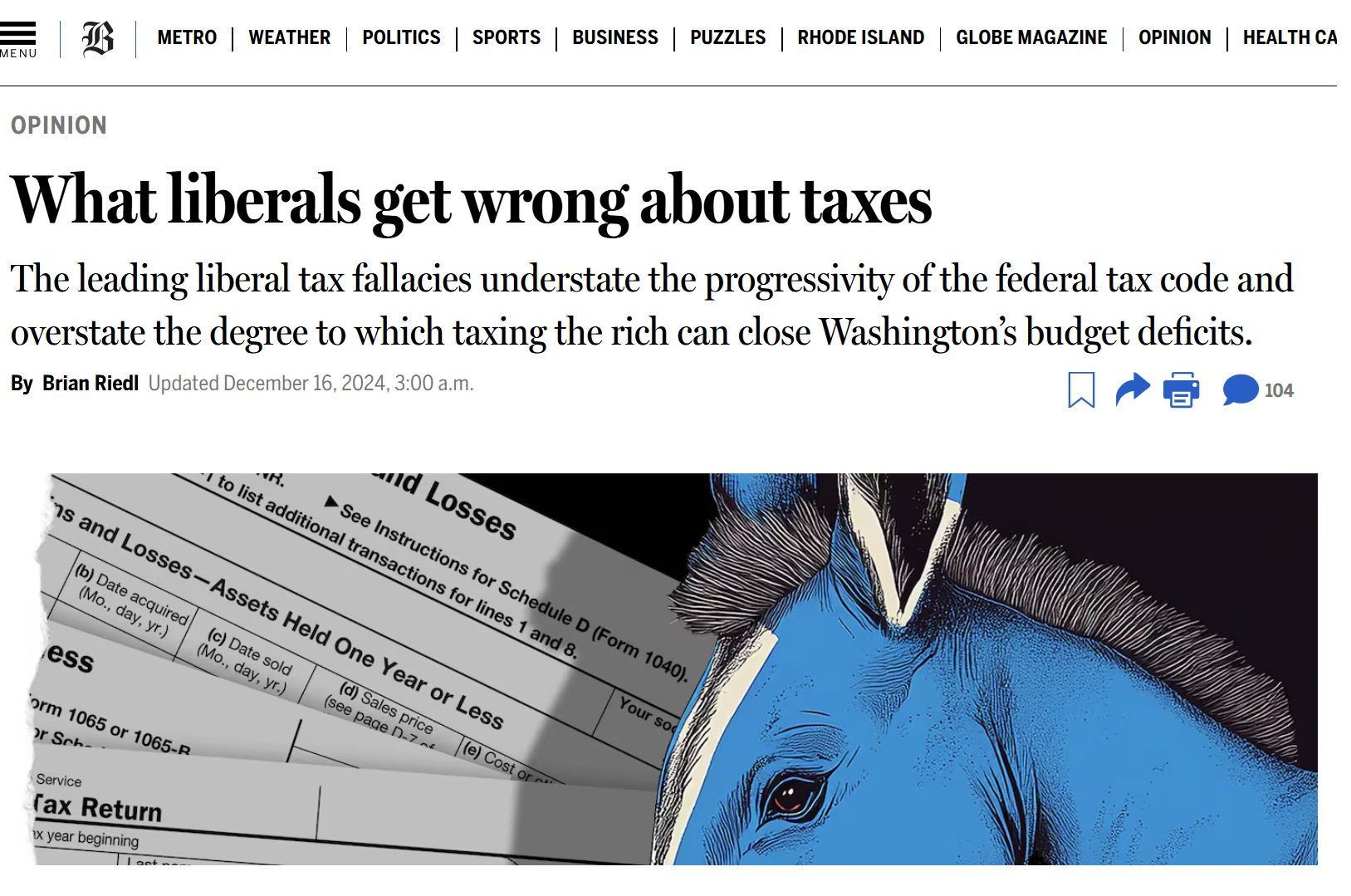
(Originally appeared in the Boston Globe)
Related: What conservatives get wrong about taxes
Surging budget deficits, a sluggish economy, and the forthcoming legislation to renew $4 trillion in expiring tax cuts are reigniting contentious debates on the US tax system. In a companion essay, I explore the leading conservative tax myths that tax cuts pay for themselves and that they induce “starve the beast” spending reductions to cut the deficit. Now, in the spirit of bipartisanship, here are the most common liberal tax myths that contradict the established tax data.
The leading liberal tax fallacies understate the progressivity of the federal tax code and overstate the degree to which taxing the rich can close Washington’s budget deficits.
The federal tax system is remarkably progressive. IRS analysis of income tax returns reveals the lowest-earning 40 percent of families paying a negative rate and the median-earning family paying an effective rate of just 2 percent. Meanwhile, the top 1 percent of earners pay an average income tax rate of 21.5 percent. When the IRS expands its analysis to include all federal taxes, the tax code remains progressive, with the bottom-earning 20 percent paying negative federal taxes, middle-earners paying around 11 percent of their income in federal taxes, and the top-earning 1 percent paying a nearly 30 percent tax rate.
Indeed, the federal tax code has grown more progressive over time, mainly due to refundable tax credits and tax relief that removed 10 million low earners from the income tax rolls. Since 1979, the share of income taxes paid by the top-earning 20 percent has jumped from 65 percent to 90 percent, while their share of all combined federal taxes has increased from 55 percent to 69 percent. The increases in the share of federal taxes paid by high earners well exceed the increase in their share of the total income earned during this period. In fact, data from the Organisation for Economic Co-operation and Development reveal that the United States has the most progressive income and payroll taxes of any OECD nation — even after adjusting for income distribution across countries.
High earners overwhelmingly fund the federal government. In 2024, the top-earning quintile paid $3.2 trillion in total federal taxes, while the remaining four quintiles paid $655 billion, $278 billion, $81 billion, and negative $20 billion, respectively. The notion that middle-earner taxes finance the federal government, while most upper-earners escape taxes, is simply false.
Moreover, the oft-cited 1950s-to-1970s era of exorbitant top tax brackets did not produce higher tax revenues. This is because a singular focus on tax rates ignores other revenue-determining factors such as the income thresholds for every tax bracket; tax preferences that shield families from higher tax rates; incentives for tax planning; tax evasion; and — most importantly — broader economic growth rates.
Thus, the 1950s and early 1960s — a period in which the top income tax rate was 91 percent — also saw the lowest federal income tax revenues (as a share of the economy) of the post-World War II era. Virtually no one had taxable incomes high enough to enter the top tax brackets and less than 1 percent of all income tax revenues came from tax brackets exceeding 50 percent. Similarly, the 70 percent top tax rates of the 1970s coincided with lower income tax revenues as a share of the economy than the post-1980 average with lower top rates.
Nor is Europe the tax-the-rich utopia that is often claimed. The United States’ top tax brackets for income, capital gains, corporate, and estate taxes each exceed the OECD average of top tax brackets. In fact, America’s top corporate and estate tax rates exceed those of the Nordic nations of Denmark, Finland, Norway, and Sweden, and its top capital gains tax rates nearly match those of Norway and Sweden.
So then how do OECD nations collect so much more tax revenue than the United States? By drastically taxing their middle class. Other OECD nations collect an average of 7.5 percent of GDP in higher revenues than the United States because every one of them imposes a value-added tax — essentially a national sales tax — that raises an average 7.2 percent of GDP in revenues. Without these VATs, which are assessed at an average rate of 19.3 percent, the OECD would nearly match the United States in tax revenues.
Even Finland, Norway, and Sweden collect 16 percent of GDP more taxes than the United States because of their much steeper VAT and payroll tax revenues — which generally hit the middle class.
Nor have “tax cuts for the rich” been Washington’s leading deficit driver. From 2000 through 2024, the federal budget declined from a surplus of 2.3 percent of GDP to a deficit of 6.4 percent of GDP. This 8.7 percent of GDP fiscal decline was the result of annual spending leaping by 6 percent of GDP, economic factors reducing revenues by 0.7 percent of GDP, and tax cuts costing 2 percent of GDP during this period. And even within the tax cuts, at most one-third (or 0.7 percent of GDP) was attributed to high-earners. In other words, tax cuts for the rich were responsible for 0.7 percent of GDP out of an 8.7 percent of GDP fiscal decline since 2000.
Taxing the rich should surely be part of an “everything on the table” bipartisan solution to deficits, although policy makers must not exaggerate the potential revenues available. Even liquidating every dollar of wealth from every American billionaire would merely finance Washington one time for 10 months. Not even 100 percent tax rates on earnings over $500,000 could balance the long-term budget.
Setting every income, investment, corporate, and estate tax at its revenue-maximizing level for corporations and earners over $400,000 — without any regard to the economic consequences — would probably raise 1 to 1.5 percent of GDP. This is not nearly enough to close budget deficits headed toward 9 percent of GDP within a decade and 14 percent of GDP within three decades under current policies. Also, the common suggestion of applying the Social Security payroll tax to all wages would keep the program out of deficit for less than a decade, according to the Social Security Administration, while using up most of the available room to raise upper-income taxes.
My purpose is not to offer sympathy for the wealthy — or to even oppose raising their taxes as part of a bipartisan grand deal on budget deficits. It is to acknowledge the unforgiving math showing that taxing the rich will not avert the need to also significantly rein in federal spending and possibly also hike middle-class taxes to stabilize the escalating debt.