

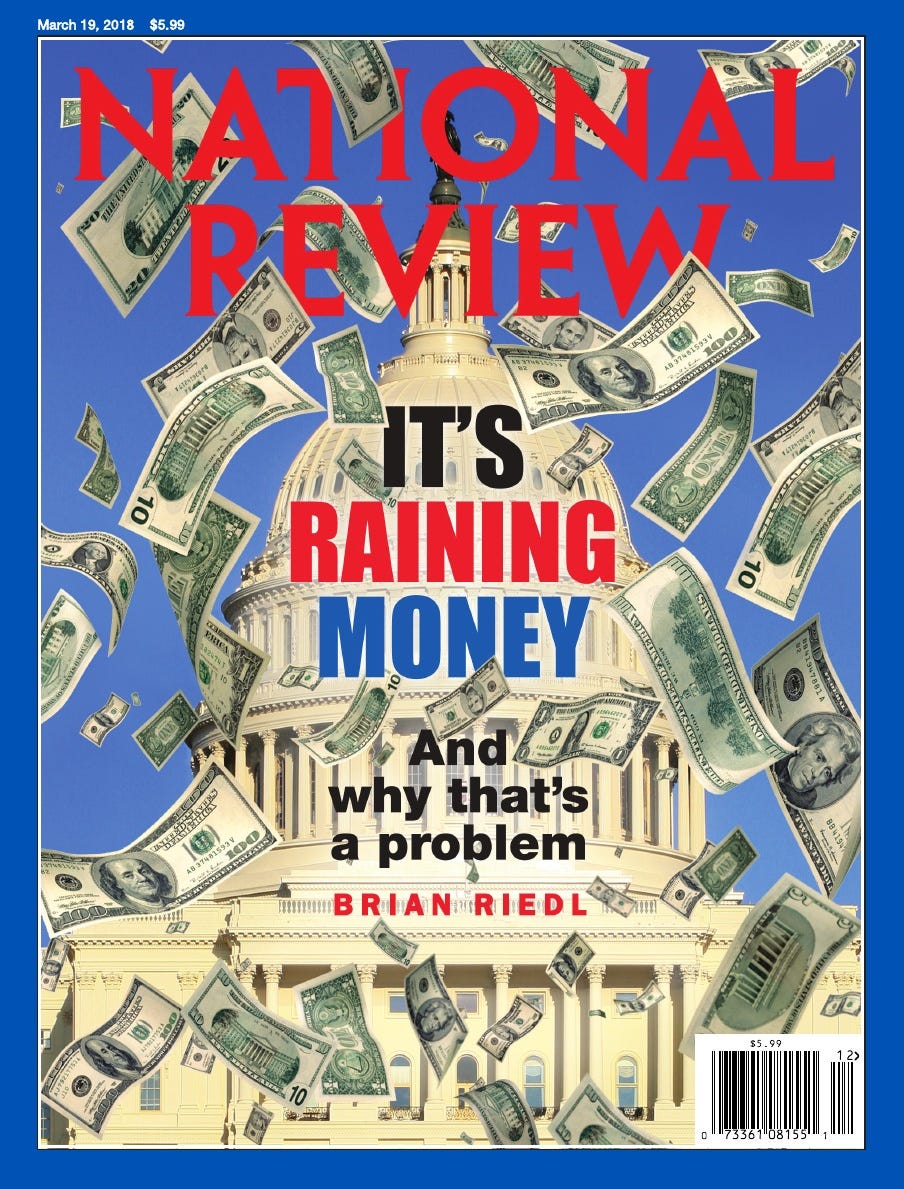
(Article originally appeared in National Review print edition)
The American polity recently tore itself apart debating the morality of adding $1.5 trillion in tax cuts to the national debt. Yet the coming $82 trillion avalanche of Social Security and Medicare debt over the next few decades elicits a collective shrug. Future historians – and taxpayers – are unlikely to forgive our casual indifference to what has been called “the most predictable economic crisis in history.”
Conservatives used to prioritize long-term fiscal solvency. For years, Republican leaders from Newt Gingrich to Paul Ryan to Mitt Romney called for reining in Social Security and Medicare before they collapse under the weight of 74 million retiring baby boomers. Then Donald Trump won 88 percent of Republican voters – and the presidency – while pledging that “there will be no cuts to Social Security, Medicare & Medicaid.” Six months later, a Pew poll revealed that only 15 percent of Republicans support trimming Medicare, and 10 percent support Social Security reform (Democratic support is 5 and 3 percent, respectively).
In other words, the entitlement reform generals have no army.
Today, Social Security and Medicare concerns are dismissed as the dying voice of the out-of-touch Washington Establishment™. For conservative leaders, the surest path to credibility with the grassroots lies in focusing on working-class “Real America” concerns like globalism and income inequality. And nothing could be more tone-deaf than depriving struggling families of their earned Social Security and Medicare benefits because of some green-eyeshade budget deficit paranoia.
Capitol Hill has taken notice. Six years ago, Congress focused on entitlement grand deals, budget caps, “SuperCommittees,” and a war on spending and debt.
Today, Republican-controlled Washington wants nothing to do with Social Security and Medicare reform, or serious deficit reduction. The spending caps are hanging by a thread, the debt limit and the ban on pork-barrel earmarks may each be eliminated entirely, and the latest Congressional Republican budget dropped the longstanding goal of achieving balance within a decade. The commendable effort to replace ObamaCare was sabotaged by Republican governors opposed to paring back Medicaid.
Even the $1.5 trillion tax cuts – despite their many merits – have poisoned the well for spending reform. It would be politically suicidal to cut taxes for corporations and then turn around and slash Medicare for seniors. Thus, when Speaker Paul Ryan recently floated an entitlement reform trial balloon, Mitch McConnell and others popped it. Too risky, too unpopular, and too partisan after cutting taxes.
II.
Looking back, the 2009-2012 tea party movement seemed like an opportunity to address the Social Security and Medicare costs driving long-term spending and debt. In hindsight, this grassroot movement’s focus was more narrow and short-term.
The tea party’s spring 2009 emergence partially reflected pent-up anger at President George W. Bush’s earlier domestic spending spree. The desire of Republican voters to support a likeable, wartime President in the face of unhinged liberal opposition had caused many to mute their frustration over No Child Left Behind, a massive farm bill, the Bridge to Nowhere, and a large Medicare drug benefit. The inauguration of a new Democratic President made it politically costless for Republicans to once again loudly oppose spending and deficits.
The primary driver of the tea party movement was the budget deficit’s recession-driven rise from $161 billion to $1.4 trillion between 2007 and 2009. Republican voters justifiably fixated on the $700 billion financial bailout and $800 billion stimulus law as unaffordable giveaways to special interests.
These first trillion-dollar deficits in history seemed to put American finances on a collision course with Greece, if not Weimar Germany. Republicans picked up 63 House seats in 2010 largely on calls to rein in spending, end the stimulus, repeal ObamaCare, and balance the budget. The tea party and new Congress geared up for a new war on spending.
Except this was not a structural deficit. It was a temporary recessionary deficit. The economy (weakly) recovered on its own, the TARP bailouts were repaid, and most stimulus spending eventually expired. Additionally, President Obama raised taxes on upper-income families by $100 billion per year and the Budget Control Act saved $100 billion per year in defense and domestic spending.
The recession-based budget deficit largely fixed itself, falling back to $438 billion by 2015 – without any Greece-style collapse or need to uproot Social Security or Medicare.
This made the anti-deficit activists look like The Boy Who Cried Wolf – bringing to mind President Reagan’s quip that “I am not worried about the deficit. It is big enough to take care of itself.”
Ross Douthat spoke for many when he recently wrote in the New York Times that, while he still supports structural spending reforms, he now believes his earlier deficit-reduction insistence was unnecessarily apocalyptic.
The Tea Party never wanted to overhaul the Social Security and Medicare systems driving the long-term debt. It wanted to rage against compassionate conservatism, Wall Street bailouts, and trillion-dollar deficits – each of which were gone by 2013.
III.
The problem with crying wolf is that Aesop’s wolf eventually does attack – and the neighbors who had been burned earlier now refuse to believe it. Similarly, the anti-deficit hysteria of the Great Recession has given way to a backlash of complacency. The entitlement-driven debt collapse seems like the future dystopia that never arrives, and therefore is no longer taken seriously.
This complacency could be catastrophic. Social Security and Medicare reform have fallen off the radar precisely when it is the most urgent.
Between 2008 and 2030, 74 million baby boomers born between 1946 and 1964 – or 10,000 per day – will retire into Social Security and Medicare. And no, the $3 trillion Social Security and Medicare Trust Funds will not save future taxpayers a dime. Those program assets also reflect a $3 trillion liability for future taxpayers, who must repay the IOUs. Thus, current spending will continue to be financed by current taxpayers.
That was alright in 1960, when five workers supported each retiree. That ratio has since fallen below three-to-one today, on its way to two-to-one by the 2030s. So by the time my daughters (ages 5 and 2) are adults, each married couple will be responsible for the Social Security and health care of their very own retiree. Imagine the burden those exorbitant taxes will place on young couples that are already struggling to buy a home and afford day care on early-career salaries.
These demographic challenges are supplemented by rising health care costs and repeated benefit expansions from Congress. Today’s typical retiring couple has paid $140,000 into Medicare, and will receive $420,000 in benefits (both adjusted into net present values). Most Social Security recipients also come out ahead. Facebook memes aside, seniors are not merely getting back what they paid in. Washington is adding 74 million retirees to a system that – by design – runs a substantial per-person deficit.
Thus, over the next 30 years, data from the Congressional Budget Office shows that Medicare will run a $40 trillion cash deficit, Social Security will run a $19 trillion cash deficit, and the interest on these program deficits will cost $23 trillion (to inflation-adjust these figures, trim by one-third). The rest of the budget will remain roughly in balance, as tax revenues continue growing faster than the economy (even if the new tax cuts are made permanent), and all other combined spending continues growing slower than the economy.
In short, the entire $82 trillion long-term deficit projection comes from the Social Security and Medicare shortfalls and their resulting interest costs. This unsustainable level of borrowing would wreak havoc on global financial markets, interest rates, and economic investment, not to mention the federal budget.
IV.
Readers should resist the temptation to roll their eyes and dismiss these 30-year spending projections. Future inflation rates are a theoretical projection. The existence of 74 million baby boomers retiring into Social Security and Medicare is an actuarial reality. Even these projections optimistically assume a slowdown in per-capita health costs. They are the rosy scenario.
Furthermore, the spending avalanche has already begun. Since 2008 – when the first baby boomers qualified for early retirement – Social Security and Medicare have accounted for 72 percent of all inflation-adjusted federal spending growth (with other health entitlements responsible for the rest). The vast majority of savings from spending caps, deep defense cuts, and rising tax revenues have simply fed the Social Security and Medicare beast, which will continue to grow by $130 billion annually over the next decade. That is the equivalent of creating another Defense Department every five years, yet it will occur automatically with no Congressional votes and scant media coverage.
And as federal resources shift to the elderly, Washington is beginning to run out of offsets. This has contributed to the deficit expanding from $438 billion to $666 billion over the past two years. Even before the tax cuts, CBO projected that annual budget deficits would surpass $1 trillion within five years, and reach $2 trillion a decade after that. Unlike the earlier recessionary budget deficit, these Social Security and Medicare-based deficits will continue expanding. Over the next 30 years, CBO projects the national debt to grow from $20 trillion to $92 trillion ($52 trillion after inflation) – or much higher if interest rates return to historically-typical levels.
These figures are so large that, at some point, something has to give. Will it be responsible policy changes, or a Greek-style crisis of debt and taxes?
V.
Politicians brush aside the issue by promising easy fixes. Tax the rich? Doubling the 35 and 37 percent tax brackets to 70 and 74 percent would close just one-fifth of the long-term Social Security and Medicare shortfall. Even seizing all annual income earned over $500,000 would not come close. Popular proposals to more aggressively tax banks, investors, hedge fund managers and oil and gas companies are a cumulative rounding error compared to these deficits.
On the spending side, slashing the defense budget to European levels would close just one-seventh of the gap. Single-payer health care would increase national health spending. Waste and foreign aid can close only a small percentage of the gap
In reality, balancing the long-term budget without fixing Social Security and Medicare (and fast-growing Medicaid) would require either nearly doubling income tax rates across-the-board, or eliminating nearly every remaining federal function.
President Trump seems to be moving towards the latter approach. Consistent with his campaign pledge, his first budget proposal allowed Social Security and Medicare spending to grow on autopilot from $1.6 trillion to $2.9 trillion over the decade. To accommodate this spending, he proposed leaving defense spending at its lowest level since the 1930s, and cutting the rest of the federal government nearly in half, as a percentage of GDP. Cheering conservatives should note that some of the steepest cuts would come not only from ObamaCare and Medicaid, but also from hefty across-the-board cuts to the non-defense discretionary portion of the budget that includes veterans’ health care, infrastructure, homeland security, and health research. Despite these savings, CBO’s score still showed a $720 billion budget deficit a decade from now (not counting the new tax cuts). After all, eliminating nearly half of non-defense discretionary spending would finance only 26 annual days of Social Security and Medicare.
Steep economic growth could close only some of the shortfall. Growth rates will already be limited by the labor force slowdown due to baby boomer retirements and declining birth rates. That leaves productivity to drive growth. Let’s bypass CBO’s projection that labor productivity will continue growing at the 1.2 percent average rate of the past 30 years, and instead permanently assume the white-hot 1.8 percent rate that prevailed between 1992 through 2005. The resulting higher incomes and tax revenues would seem to close 40 percent of the funding gap – until one accounts for higher incomes also automatically raising Social Security benefits when these workers retire. Wealthier retirees would also likely consume more Medicare benefits because the copays would be more affordable, further reducing the savings. A strong economy is necessary, yet not sufficient.
Nor can purposeful inflation avert difficult choices. In the short-term, higher inflation can dilute some of today’s $20 trillion national debt. However, Social Security and Medicare benefits and payments are also tied to inflation, so future liabilities would expand. Additionally, Washington would have to pay much higher interest rates when borrowing to finance those benefits.
On the flip side, low interest rates also cannot make this debt affordable. CBO’s projected $92 trillion national debt 30 years from now already assumes that interest rates remain far below historically-average levels. The soaring national debt is more likely to raise interest rates, adding tens of trillions more in interest costs to this rosy scenario.
Finally, this leaves the “too damn bad, kids” argument that Social Security and Medicare represent an unbreakable, unamendable bond between generations, consequences be damned. Of course, today’s teenagers never signed up for this budget-busting deal. Besides, benefits have been repeatedly expanded far beyond what current retirees were promised while working. For example, President Bush and Congress decided in 2003 that taxpayers would pay 75 percent of the typical seniors’ prescription drug costs – with no payroll tax increase to “earn” this benefit. Why is that unearned handout any more sacred than Medicaid or Food Stamps? And with current- near-retirees statuses as the wealthiest age groups (even when excluding their illiquid home equity), these expanded benefits are difficult to justify.
VI.
Moving forward, those reasonably claiming “I just want the benefits I earned!” should be considered allies for reform. Setting lifetime Social Security and Medicare benefits equal to the net present value of each person’s lifetime contributions to the systems – and not a penny more – would eliminate most of the long-term shortfall.
More realistically, Social Security can be addressed by gradually raising the eligibility age and more aggressively means-testing benefits for wealthy retirees. Medicare reform can require that upper-income seniors pay the full cost of their physician and drug coverage (which, unlike hospital coverage, are not “earned” with prior payroll taxes), and eventually transitioning to a premium support model that harnesses private sector choice and competition to slow cost growth.
These proposed reforms would largely shield younger taxpayers, because drowning the next generation in taxes is no better than drowning them in debt.
Restructuring cannot wait. Every year of delay sees four million more baby boomers retire and lock into benefits that will be difficult to alter – making the eventual fixes more expensive and more tax-heavy.
The window is closing fast on the longstanding promise to exempt current and near-retirees. More than one-third of all baby boomers have already retired, and another third will retire over the next six years. When the benefits of 74 million baby boomers are set to bury the federal budget, grandfathering them out of reform defeats the very purpose of reform.
VII.
Surveys suggest the American people do not want a conversation about Social Security and Medicare. We want to spend one-third of our adult lives in taxpayer-funded retirement. We also want to preserve defense, welfare, infrastructure, veterans’ and other spending priorities all without stratospheric tax increases.
Today’s politicians do not want this conversation, either. They came to Washington to play Santa Claus, not the Grinch. Neither party wants to sign up for a suicide mission, especially if the other party is not on board.
It was far easier to cut taxes by $1.5 trillion, which simultaneously reflected strong tax policy and delusional budget policy. Unless Washington reins in Social Security and Medicare, no tax cuts can be sustained over the long-run.
Ultimately, the math always wins. The deficit will continue expanding, key programs will continue to be squeezed, and taxes will start rising until politicians and voters finally confront the elephant in the room.
Frédéric Bastiat long ago observed that “Government is the great fiction through which everybody endeavors to live at the expense of everybody else.” Reality will soon fall like on anvil on Generation X and millennials, as they find themselves on the wrong side of the largest intergenerational wealth transfer in world history.