

(Originally published in The Dispatch)
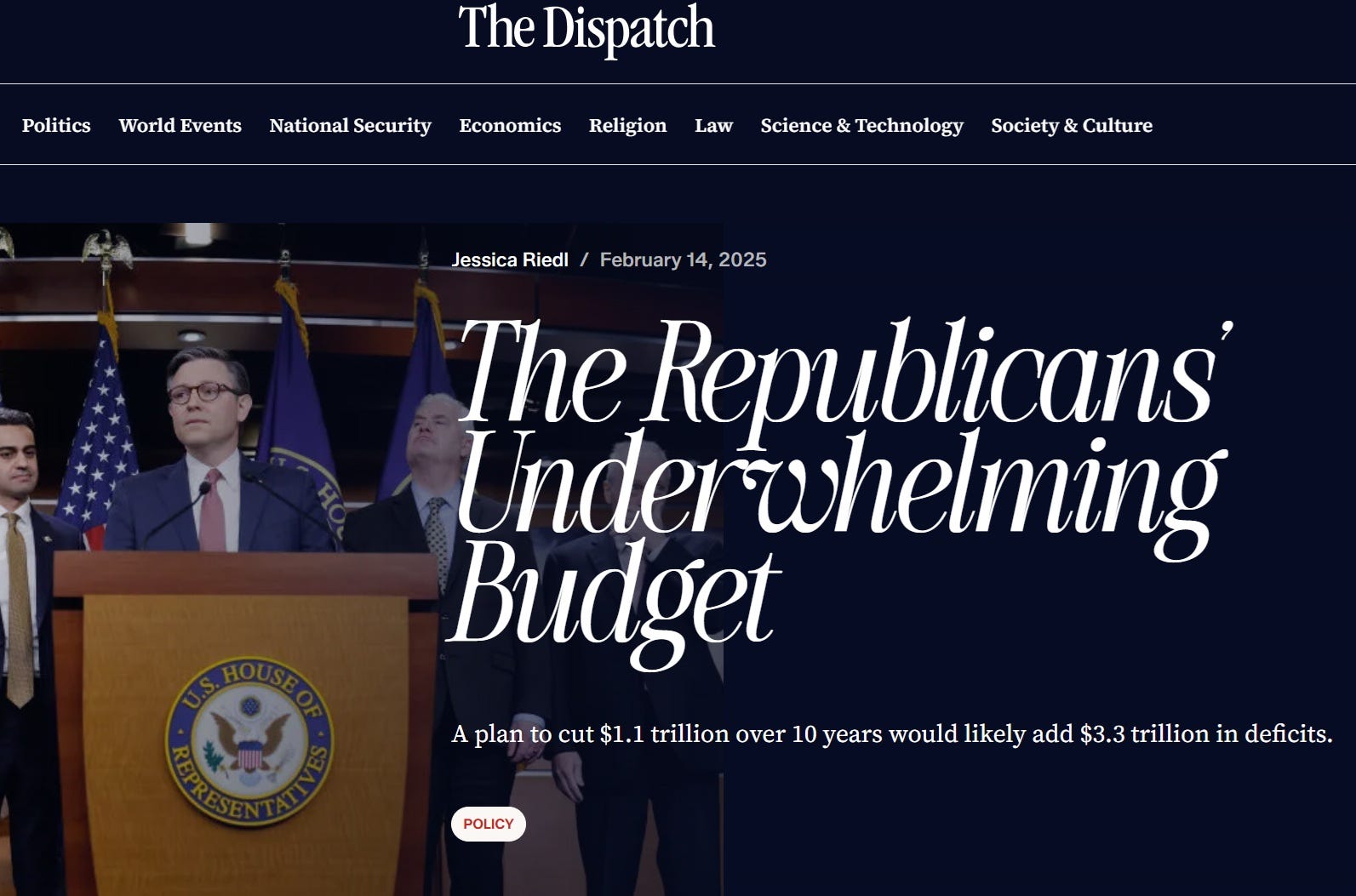
After much fanfare, the House GOP majority has released its latest 10-year budget blueprint. Up until now, Elon Musk and his Department of Government Efficiency (DOGE) have controlled Washington’s fiscal narrative with high-profile attempts to cancel government contracts, remove federal employees, and shut down the agency in charge of distributing international aid assistance.
While DOGE has trumpeted its (unverified) claims of saving a few billion dollars here and there, the new House budget resolution would likely add $3.3 trillion to 10-year deficits. These costs will dwarf the largely symbolic DOGE budget savings and show a Republican government once again dramatically driving budget deficits upward.
Real tax cuts, gimmicky savings.
The Congressional Budget Office’s latest baseline projections show Washington running $21 trillion in budget deficits over the 2025-2034 period covered in the Republican budget proposal, pushing the federal debt held by the public from $29 trillion to $50 trillion. That rosy scenario assumes no wars, no recessions, low interest rates on the federal debt, and nearly unprecedented limits on discretionary spending.
Against that baseline, the House GOP blueprint claims to save $1.1 trillion over the decade. In reality, it will likely add $3.3 trillion in debt. Specifically, tax cut extensions will cost $4.5 trillion but are offset only partially, with $1.2 trillion in mandatory program savings. The blueprint also includes promises of $2.6 trillion in additional tax revenues based on economic growth and $1.8 trillion in future discretionary spending savings, but those should be classified as gimmicks.
Start with the tax cuts. The House Ways and Means Committee received reconciliation instructions from this legislation to build a package adding $4.5 trillion to 10-year deficits, which should cover the roughly $4 trillion cost of extending the expiring Tax Cuts and Jobs Act. But that may not leave enough room to expand the state and local tax (SALT) deduction or include President Trump’s calls to end taxes on tips and overtime.
The committee could incorporate all these tax relief measures if it is willing to offset them with other tax increases or savings from the spending programs it oversees such as Medicare. It is more likely that Congress will add SALT relief and maybe tax-free tips, while shortening the tax cuts’ time frame from 10 years to perhaps seven years. But shortening the timing window is merely a gimmick given the likelihood that Congress simply renews the tax relief again at the next expiration date, ultimately raising the 10-year cost.
The $1.2 trillion in mandatory spending savings promised over the decade are legitimately presented yet face an uphill battle with a razor-thin House majority. The largest savings would consist of $880 billion over the decade from the Energy and Commerce Committee (almost certainly Medicaid reductions), $330 billion to be cut by the Education and Workforce Committee (most likely from student loans), and $230 billion in savings assigned to the Agriculture Committee (likely from SNAP food assistance). On the flip side, the budget would allow the Armed Services, Judiciary, and Homeland Security committees to collectively add $300 billion in 10-year spending for defense, border security, and likely immigrant deportations.
No Republican Congress in modern times has produced mandatory savings anywhere close to the $1.2 trillion targeted in this budget resolution. In fact, the last unified GOP Congress reduced its 10-year mandatory savings promises from several trillion dollars down to $320 billion and then down to just $1 billion—and then defeated that bill. Large cuts to Medicaid, student loans, and SNAP programs would require nearly unanimous GOP support, even as governors balk at Medicaid cuts and Democrats argue—legitimately—that Republicans are “slashing programs for the poor” to pay for “tax cuts for the rich” rather than deficit reduction. This is why I have repeatedly written that passing dramatic spending cuts on a party-line basis is nearly impossible politically. While few voters like compromising their preferred policies, building a more balanced savings package together with the opposing party can provide the bipartisan political cover necessary to pass the bill through Congress without it becoming a political suicide mission.
The final two savings categories—discretionary spending cuts and projected revenue from economic growth—should be dismissed as gimmicks. The Republican budget assumes $1.8 trillion in unspecified future discretionary spending savings. This would drive discretionary spending as a share of the economy to 25 percent below current levels, and to its lowest level since the 1930s. Given that most discretionary spending goes to defense, veterans, and border security, it is difficult to take seriously these promises of substantial undefined savings some time down the road. It is even more difficult to take such a pledge seriously when the same legislation includes the aforementioned reconciliation instructions to add $300 billion for defense and border security. Promises of considerable but undefined discretionary spending reductions sometime in the future have long been a staple of Washington budget proposals. They should not be taken seriously.