


CLICK HERE for full report at the Brookings Institution
Social Security and Medicare finances are headed for a reckoning. Social Security has run an annual deficit since 2010, and its trust fund is projected to become insolvent by 2032.1 The Medicare Part A trust fund is projected to follow in 2033.2 Trust fund accounting may sound like a green eyeshade technicality, but it is only one symptom of the broader unsustainability of both programs.
Consider that:
Far from paying for themselves through payroll taxes and premiums, Social Security and Medicare are running a combined $847 billion cash shortfall in 2026—comprising roughly half of the entire federal budget deficit.3
Their combined shortfall is projected to reach $2.7 trillion a year within a decade, becoming the overwhelming driver of rising federal budget deficits.4
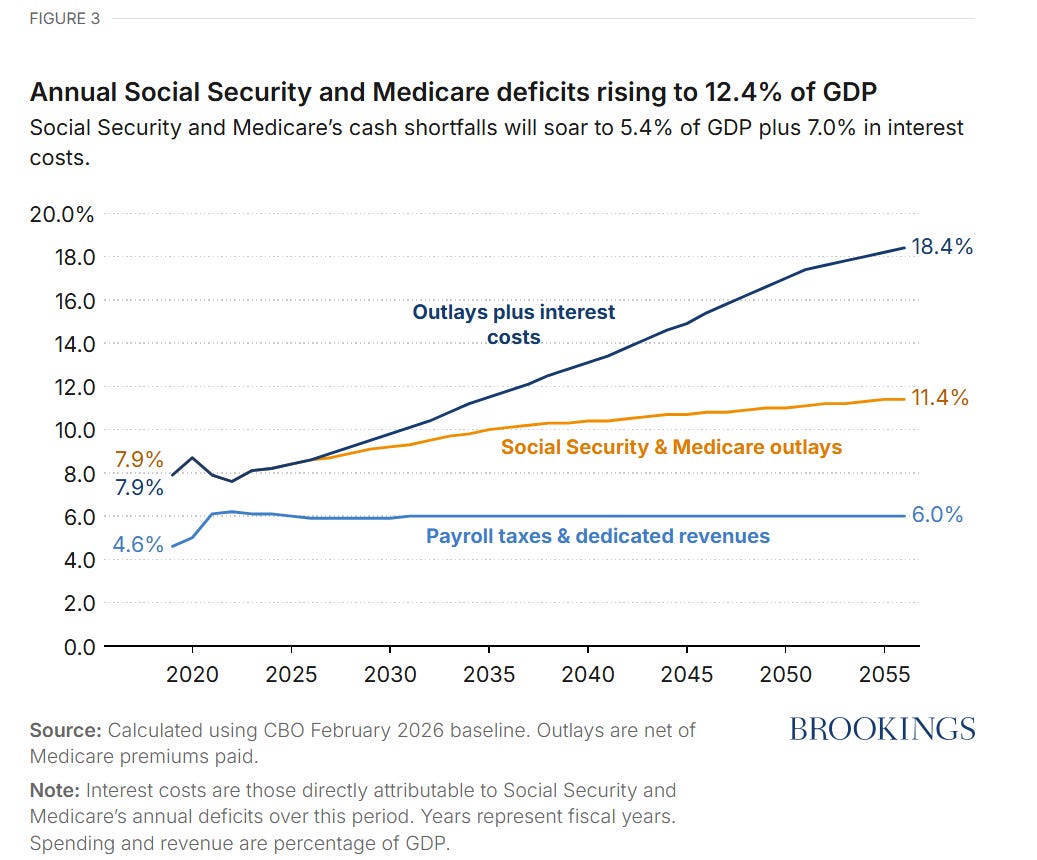
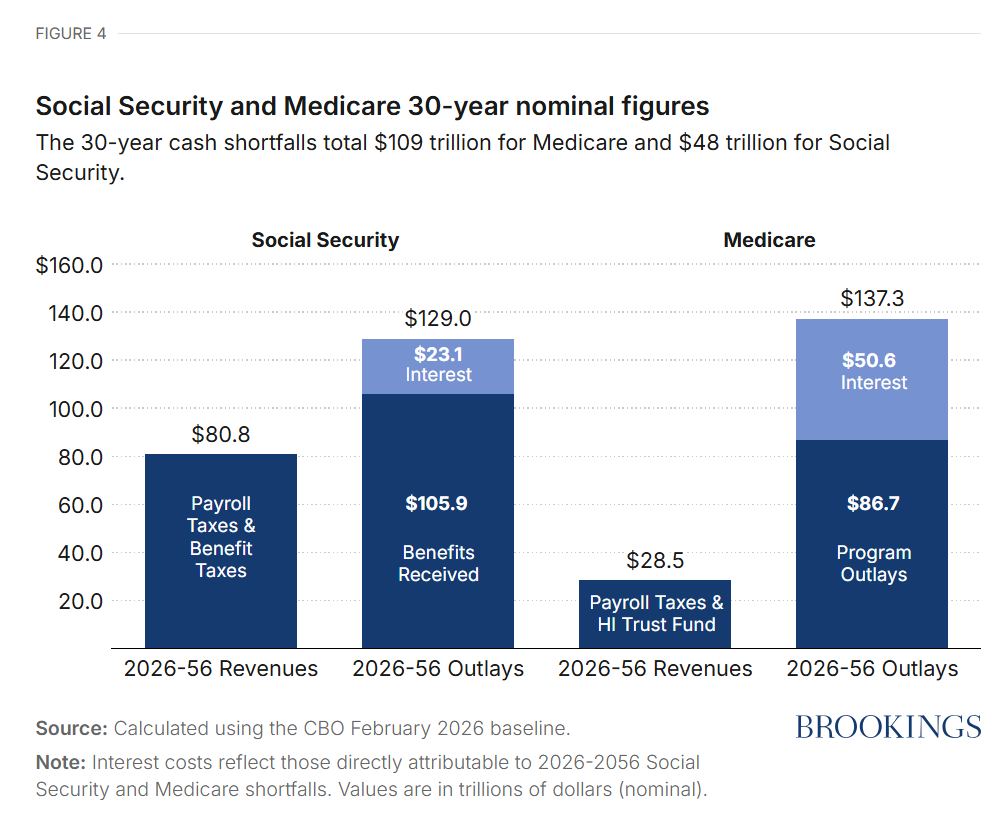
Over the following three decades, the two programs are projected to run a cumulative cash shortfall of $157 trillion, with the annual gap reaching 12.4% of GDP by 2056.5
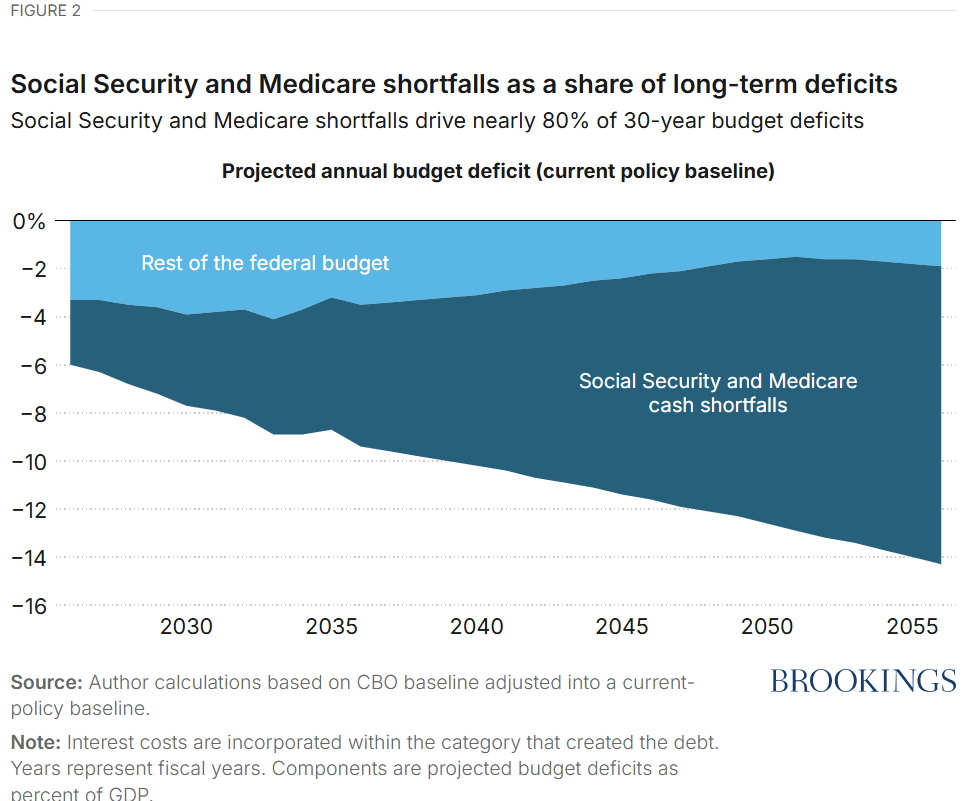
All told, these shortfalls will account for nearly 80% of all federal budget deficits projected over the next three decades.
Clearly, something has to give—before these shortfalls drive the federal debt to a projected 240% of GDP within thirty years and push interest costs high enough to consume a majority of annual tax revenue.6 Both parties created this unsustainable path, repeatedly expanding Social Security and Medicare benefits well beyond available revenues while failing to account for longer lifespans, fewer workers per retiree, and rising health care costs.
Nor has either party offered a solution. Republican lawmakers take new taxes off the table, while President Trump opposes any benefit reductions. Democratic leaders take benefit changes off the table while pledging to limit new taxes to the wealthiest families and corporations. Neither side will admit that reining in these costs will require both reductions in scheduled benefits and new broad-based taxes.
This report aims to show that Social Security and Medicare sustainability reforms can be designed within progressive principles of protecting low-income seniors and promoting income redistribution down the income ladder. Specifically, it shows that:
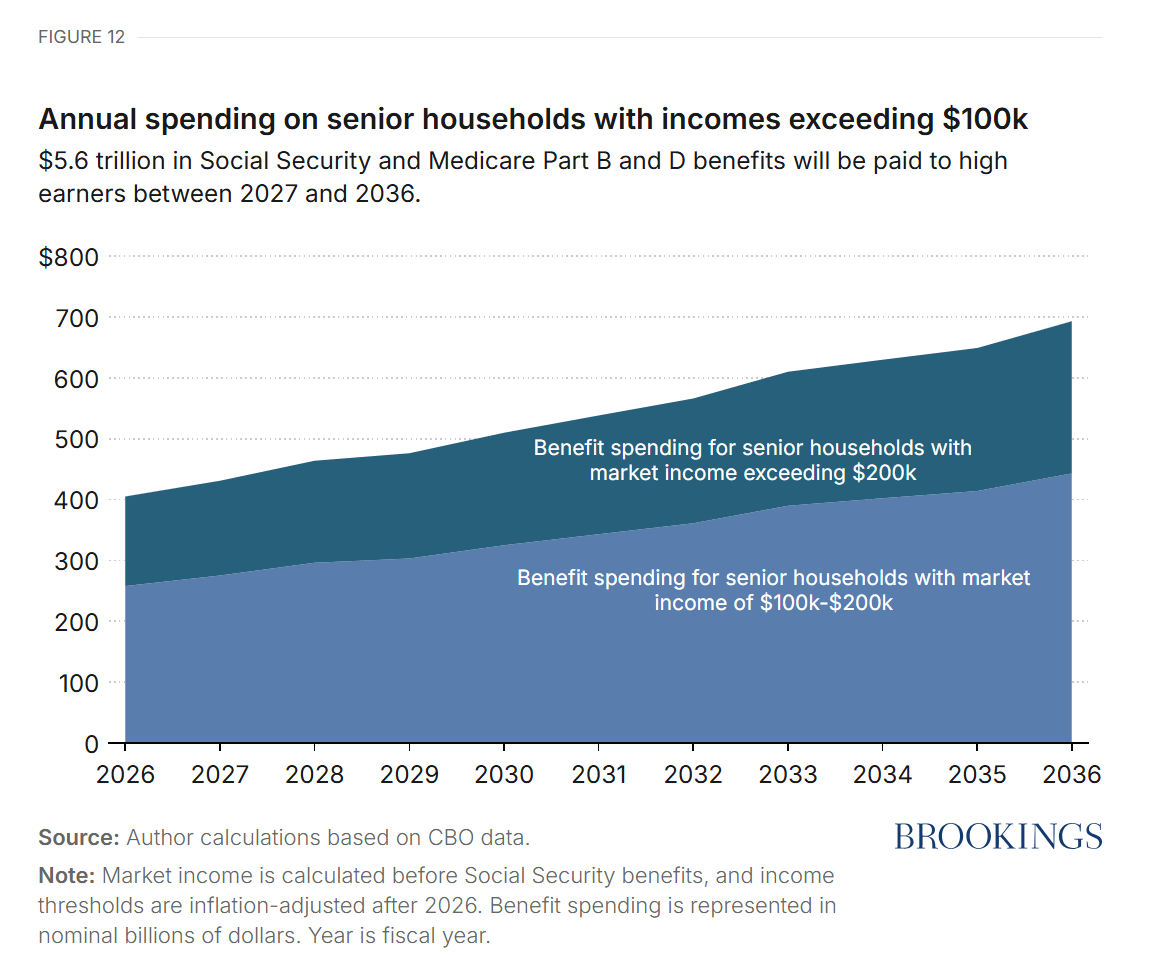
A) While benefits for the poorest seniors must be protected, a growing share of today’s Social Security and Medicare spending redistributes income upward—from working families to millions of wealthier seniors whose benefits often far exceed their lifetime contributions to the system. This includes close to $5.6 trillion in benefits set to be paid over the next decade to seniors with pre-benefit incomes over $100,000 (in 2026 dollars), including $2.0 trillion to those above the $200,000 threshold.
B) The soaring cost of these benefits threatens to absorb every plausible tax increase on the wealthy, and even on the non-wealthy, leaving little or no room to fund other progressive priorities such as education, health care, climate, and childcare.
C) Because sharp tax increases face broad opposition, escalating Social Security and Medicare costs are already squeezing spending on other progressive programs—a trend likely to accelerate.
While the “just tax the rich” approach remains popular among progressives, the notion that it alone can close all or even most of a thirty-year, $157 trillion shortfall collapses under scrutiny. Mathematically, even seizing every dollar of billionaire wealth or taxing millionaires at 100% tax rates would fall short.7 Economically, marginal rates on top earners can rise only so far before the resulting economic and incentive effects begin to erode revenue. And politically, for nearly a century even unified Democratic governments have proven unable to enact substantial upper-income tax increases outside of major wars—a constraint likely to persist as Democrats increasingly represent the highest-earning regions, such as California and New York. Taxing the rich belongs in any sustainability plan, but it cannot spare middle-class taxpayers or other spending programs from bearing much of the cost.
Given these constraints, continuing to give retirement benefits for (often wealthy) seniors the first claim on federal revenue will force other priorities—poverty relief, education, health care, climate, childcare, family leave, and infrastructure—to compete for a shrinking pot of remaining tax dollars. Progressives can instead protect the poorest seniors, rein in benefits for wealthier ones, and reserve most new tax increases for those other priorities.
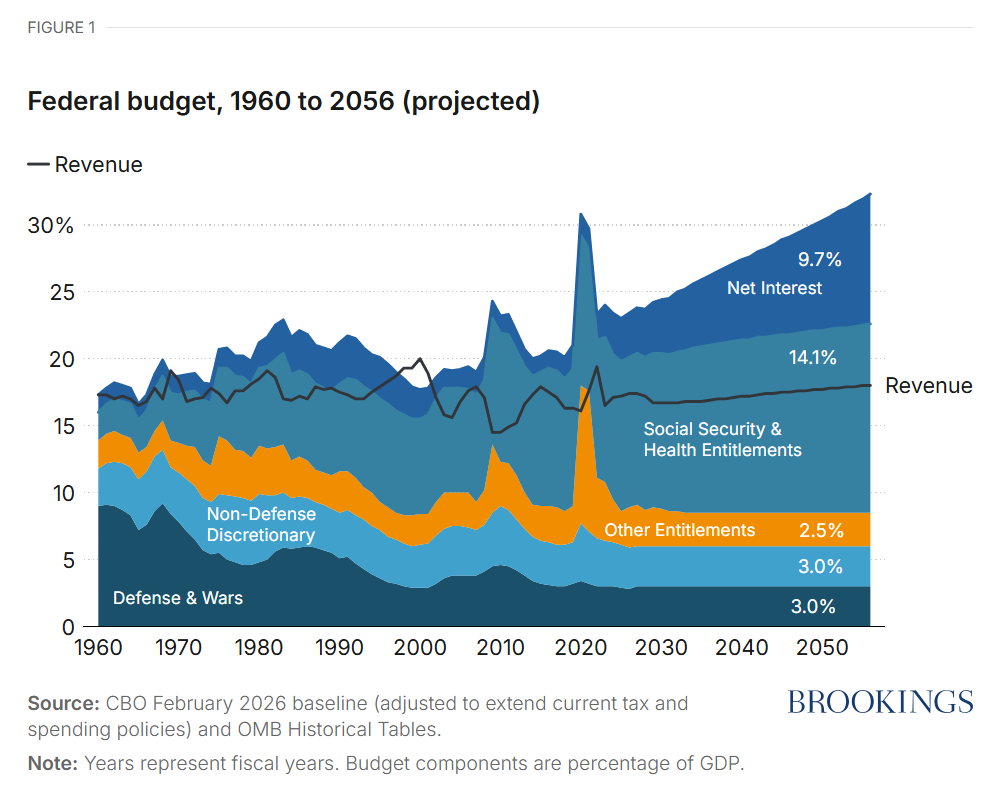
Part 1: Federal spending on seniors is growing to unsustainable levels
This part dissects Social Security and Medicare’s projected three-decade cash shortfall of $157 trillion and the mathematical inability of taxing the rich or slashing lower-priority spending to close such a large fiscal gap. Instead, leaving senior benefits unreformed will inevitably drive up middle-class taxes and force significant cuts to popular social programs.
Why senior benefit costs are swallowing the federal budget
While Social Security and Medicare finances often inspire passionate political arguments, they are not well understood by the public. Social Security was originally sold as pure social insurance, a zero-net-cost federal program in which workers would pay payroll taxes during their career and then collect those dollars at retirement. Medicare, enacted three decades later, was often seen as similarly structured.
This narrative was never accurate. Social Security immediately began paying benefits to seniors who had never contributed significant payroll taxes (because the system had not existed during their working years), and benefit levels were never limited to an individual’s tax contributions. And despite a popular myth suggesting otherwise, Social Security can and does run significant budget deficits, as described in the appendix.
On the Medicare side, only Part A (hospital insurance) benefits were tied to earlier payroll taxes. By contrast, Medicare Part B (physician care) and Part D (drug coverage) function not as social insurance, but rather as traditional welfare policies. Seniors sign up at retirement, pay (typically) 25% of the Medicare Parts B and D premiums, and then taxpayers pay the remaining 75%.8 None of those Part B and D benefits are “earned” with earlier payroll taxes.
Because current payroll taxes fund current beneficiaries (rather than being saved in any fund), Social Security and Medicare Part A can remain financially stable only by maintaining a healthy ratio of workers to retirees, a sufficient payroll tax rate, and lifetime benefits that do not expand beyond the system’s financial resources. While payroll tax rates have gradually risen to 12.4% for Social Security and 2.9% for Medicare, benefit costs have grown significantly faster than revenues and the broader economy.
The first reason is demographics. Since 1976, the share of Americans ages 65 and older has leaped from 10.5% to 18.8%—on its way to a projected nearly 24% in 2056.9 This has been driven by 77 million retiring baby boomers as well as expanding lifespans.10 Among the generation that reached age 65 in 1950, only about 61% of those who had survived to adulthood went on to reach 65, and those who did lived an average of 14.7 more years.11 For the generation reaching 65 in 2030, average life expectancy at 65 rises to roughly 20.8 years—about six more years of benefits.12 And survival to retirement is far higher: under today’s mortality rates, about 84% of 21-year-olds reach 65.13
While expanded life spans are obviously good news, this means the share of workers supporting each retiree—5.1 in 1960—has fallen to 2.6 in 2026, heading toward 2.0 over the next several decades.14 This approximate 2-to-1 ratio means that, on average, each working-age married couple would have to support the Social Security and Medicare benefits of their own retiree—on top of typical family expenses like housing, childcare, and student loan repayments. Moreover, at least 30% of the generation reaching 66 today will live to age 90—and thus spend one-third of their adult lives collecting taxpayer-funded Social Security and Medicare benefits.15
These demographic challenges are supplemented by the additional challenge of notably rising per-capita benefits and costs. Within Social Security, as mentioned earlier, the wage-indexing of initial benefit formulas results in inflation-adjusted Social Security benefit levels growing more generous for each successive generation. Within Medicare, per-capita health care costs have typically grown faster than inflation as well as the rate of economic growth, forcing the government to incur significantly rising costs over time just to provide the same benefits to a demographically similar population.16
These factors explain why the typical-earning married couple retiring at age 65 in 2025 will receive Social Security and Medicare benefits that together exceed their lifetime contributions by more than 50%—even after adjusting to net present value.17
Social Security and Medicare’s $157 trillion cash shortfall
Throughout the 1980s and 1990s, Social Security and Medicare had a combined federal budget imprint that was relatively neutral. Social Security ran annual surpluses that were approximately offset by Medicare’s annual shortfalls, which primarily resulted from Medicare Part B’s reliance on general revenues. Then, in the 2000s, the baby boomers began retiring and Social Security surpluses were gradually replaced with deficits. Medicare shortfalls also began rising steeply due to those retirements, rising health care costs, and the 2003 enactment of Medicare Part D.
By 2026, Social Security and Medicare’s combined annual shortfall has soared to 2.7% of GDP.18 Specifically, Social Security and Medicare are estimated to take in a combined $1,882 billion in dedicated revenues and spend $2,729 billion on benefits and interest. The resulting $847 billion cash shortfall is responsible for nearly half of the estimated $1.8 trillion budget deficit. And even this figure understates Social Security and Medicare’s burden by excluding the share of rising federal interest spending that is directly attributable to these systems’ growing contribution to the federal debt.
The aging of the population, automatic benefit increases, and rising health care costs are projected to continue driving up Social Security and Medicare’s annual shortfalls. By 2036, Social Security and Medicare are projected to bring in $2,793 billion in payroll taxes and related revenues yet cost $4,717 billion in benefits plus $813 billion in resulting interest costs—for a total annual shortfall of $2,737 billion, or 5.9% of the economy.19 Over three decades, Social Security and Medicare face a projected cumulative shortfall of $157 trillion,20 with the annual shortfall reaching 12.4% of GDP by 2056.21 These cash shortfalls (including resulting interest costs on the debt) total $109 trillion for Medicare and $48 trillion for Social Security.22
If not for Social Security and Medicare’s staggering cash shortfalls, the federal budget outlook would appear dramatically better. Outside of these two programs, budget deficits over the next three decades are projected to average just 2.8% of GDP under a current policy baseline that assumes a continuation of all current tax cuts and spending levels. Because deficits of that size would grow more slowly than the nominal economy, they would gradually reduce the federal debt as a share of the economy. Instead, Social Security and Medicare shortfalls are projected to comprise 77% of total federal budget deficits over the next three decades.23
It is fair to ask why Social Security and Medicare should be held to a standard of funding themselves through payroll taxes, premiums, and other dedicated trust fund revenues. After all, Medicare Parts B and D are designed to be majority-reliant on general revenues, and virtually no one demands that the Department of Defense, for instance, fund itself outside of general revenues. However, Social Security and Medicare Part A were designed and promoted based on fully funding themselves within these (reasonably generous) dedicated revenue constraints to limit costs and preserve general revenues for other federal priorities.
More importantly, the cost trajectory is the problem. If Social Security and Medicare consistently required an outside revenue stream of perhaps 1 or 2% of GDP, such a cost could be reasonably incorporated into the federal budget and financed by other means. Instead, as a federal budget line item, these general revenue costs have leaped from zero to 2.7% of GDP and are projected to further swell to 5.9% of GDP within a decade and 12.4% of GDP within three decades when including the resulting interest costs.24 Giving any federal program—including defense—a blank check for such steeply swelling costs is not sustainable. These shortfalls will require some combination of steep tax increases, substantial reductions to other spending programs, or rapidly rising government debt. The result could be a European-level tax burden without the European social benefits for working families.
Limited space for a tax solution
A common response to surging Social Security and Medicare shortfalls is to assert that they can be easily solved by raising taxes (particularly on the rich). While such a policy response may have sufficed decades ago when program shortfalls were more manageable, the current and future-projected shortfalls exceed the realistic level of tax increases.
Social Security and Medicare’s annual non-interest shortfalls are currently 2.7% of GDP and projected to rise to 5.4% of GDP within three decades—which when applied to the 2026 GDP is equivalent to $847 billion annually in 2026 rising to $1.73 trillion annually within three decades.25 Enacting such a substantial tax increase would be enormously difficult. After all, President Obama was unable to significantly raise taxes even with a filibuster-proof Democratic Congress.26 And President Biden—with a Democratic Congress for half of his term—was able to raise net taxes by an average of $5.8 billion annually.27 The last significant Democratic tax increase was in 1993, when President Clinton persuaded a Democratic Congress to hike taxes by 0.63% of GDP28 (leading to the Democrats’ landslide loss of Congress the following year), and that level has rarely been exceeded in modern American history outside of major wars.
Current political barriers to major new tax increases are numerous. They include: 1) bipartisan pledges not to raise taxes on families earning under $400,000; 2) global tax competition and capital mobility putting downward pressure on corporate, capital gains, and wealth taxes; 3) Democratic representation of wealthier regions such as Manhattan, Hollywood, and Silicon Valley eroding their willingness to dramatically raise taxes on their own voters; and 4) smaller congressional majorities incentivizing both parties to prioritize popular handouts over the imposition of new burdens. While “fair share” tax increases will remain a regular applause line in Democratic (and even some Republican) circles, recent history suggests no plausible path for the substantial tax increases necessary to close the Social Security and Medicare shortfalls without also significantly reforming benefits.
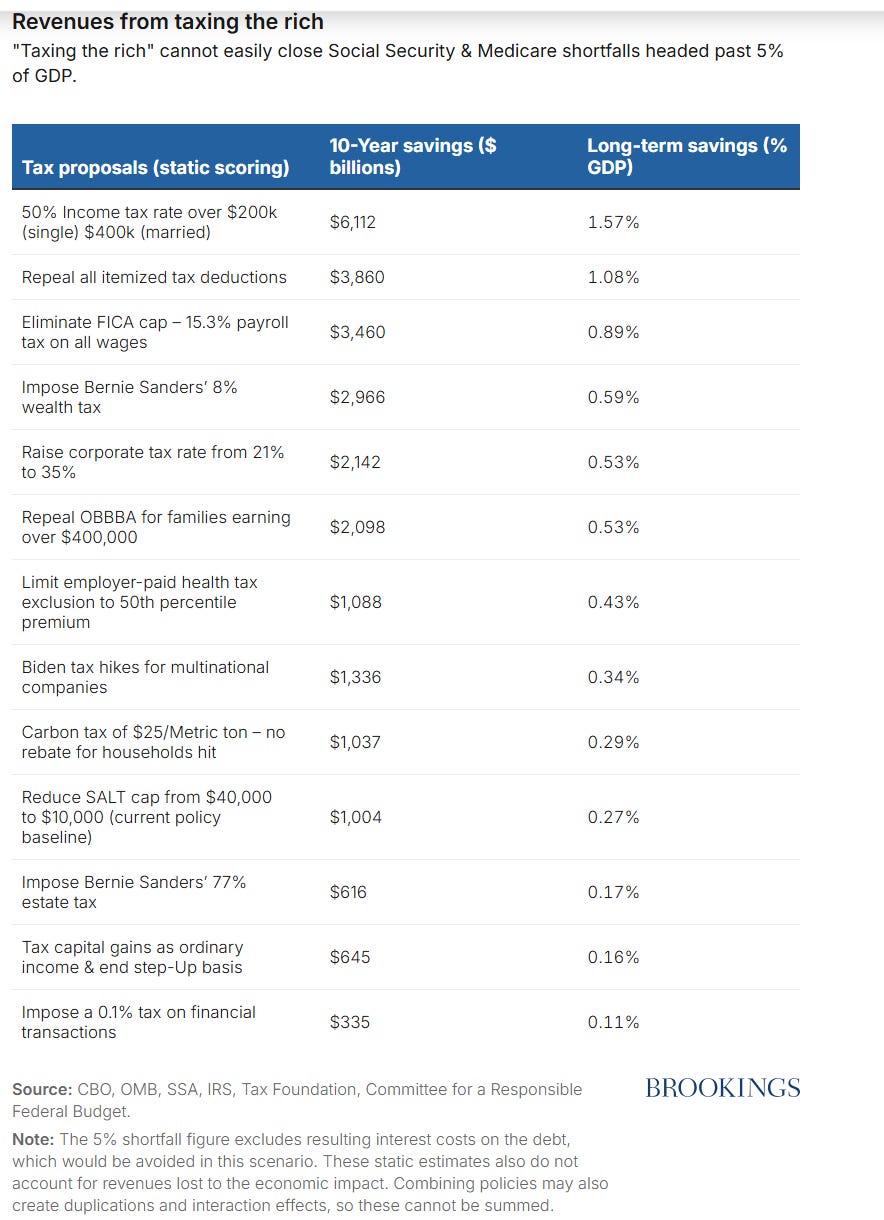
Setting aside the political barriers, designing a tax increase even close to 2.7% of GDP in the short-run and 5.4% of GDP in the long-run can be extraordinarily challenging. Table 1 shows the potential annual revenues to be raised from popular “tax the rich” policies, such as:
Imposing a 50% income tax rate for taxable income exceeding $200,000 (single) and $400,000 (married filing jointly) (1.57% of GDP);
Imposing Sen. Bernie Sanders’ wealth tax as high as 8% (0.59%);
Hiking the corporate income tax rate from 21% all the way back to 35% (0.53%);
Aggressively taxing multinational corporations (0.34%);
Imposing Sen. Bernie Sanders’ 77% estate tax (0.17%);
Taxing high earners’ capital gains and dividends as ordinary income (0.16%); and
Imposing a new tax on financial transactions (0.11% of GDP).29
Even combining all these tax increases would raise about 3.5% of GDP—a figure that likely falls closer to 2.5% when accounting for interactive effects of layering them on top of each other. It would leave the U.S. among the developed world’s highest tax brackets for income, corporate, capital gains, wealth, and estate taxes. And it would still be far short of the long-term target of 5.4% of GDP in required savings.
Realistically, a tax-only solution to closing long-term Social Security and Medicare shortfalls would require significant middle class tax increases. This could include an across-the-board ten percentage point rise in the payroll tax (3.74% of GDP) or income tax (3.47% of GDP), or a 20% value-added tax (2.80% of GDP)—with 100% of the tax revenues earmarked for seniors.30
Repealing the payroll tax cap is no panacea.
The common progressive proposal of lifting the $184,500 cap and applying Social Security taxes to all wages is particularly instructive. It would raise approximately 0.9% of GDP in revenues which is enough to close around three-fifths of the long-term Social Security shortfall of 1.5% of GDP before accounting for revenues lost to the resulting economic damage.31 According to the Social Security Trustees, the system would return to deficit within just three years.32 Long-term Social Security solvency would still require additional new taxes or benefit changes.
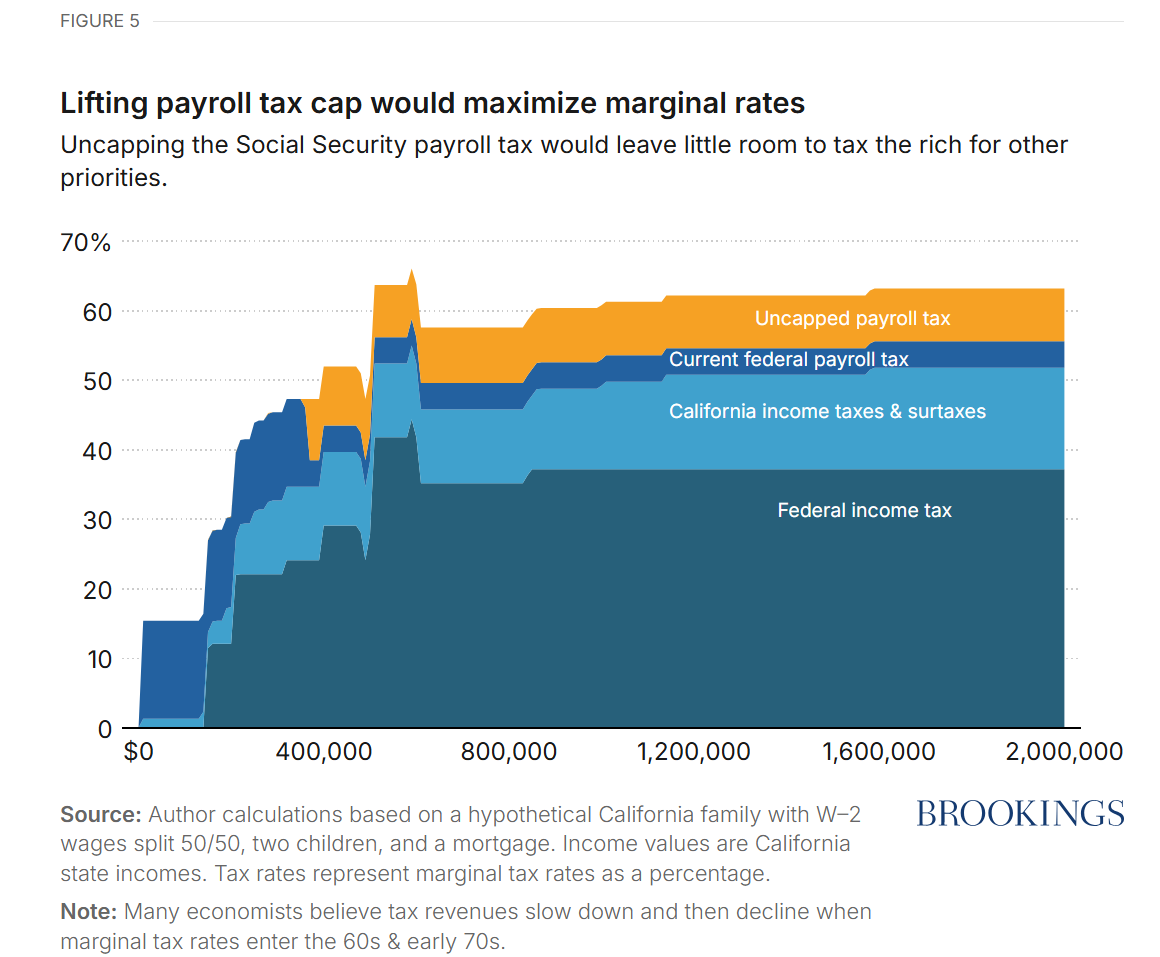
Yet more potential complications arise. Raising the payroll tax by 12.4% (assuming the employee bears the full economic burden of the tax) would push the highest combined (federal income, state income, and payroll) marginal tax rates to 63.2% in high-tax states like California.33 This would approach what is typically considered the revenue-maximizing tax rates for high-earners. Even liberal economists34 note that the additional revenue from higher marginal tax rates eventually begins slowing down and then turns negative somewhere between 60 and 73% as high-earners either stop earning additional wages or shift their compensation to lower-taxed investments.35 This is why those 91% tax rates from the 1950s affected only a few hundred families and likely lost tax revenues.36 Income tax revenues rose as a share of the economy when those tax rates were finally repealed because the less punitive tax rates increased incentives to earn income and reduced incentives to shelter it from the IRS.37
Consequently, uncapping the payroll tax rate and applying the revenues to Social Security would still leave a remaining Social Security shortfall of 0.6% of GDP, plus a Medicare shortfall rising to 3.9% of GDP38—and without the ability to further raise income or payroll taxes on the wealthy.
This brings an important consideration: Even if it were possible to fully fund Social Security and Medicare indefinitely by maximizing “tax the rich” policies and then persistently raising middle class taxes over the next few decades to their highest peacetime levels in American history, would that be a wise policy? Earmarking nearly all potential taxes to financing Social Security and Medicare shortfalls would leave little-to-no room to raise taxes to finance new initiatives in poverty-relief, education, health care, veterans’ benefits, climate policy, childcare, family leave, or infrastructure. It is unclear why senior benefits—including for wealthy seniors—should be prioritized over those progressive priorities when allocating potential new tax revenues. Paring back certain Social Security and Medicare costs would thus create more fiscal space for progressive priorities.
Crowding out other spending
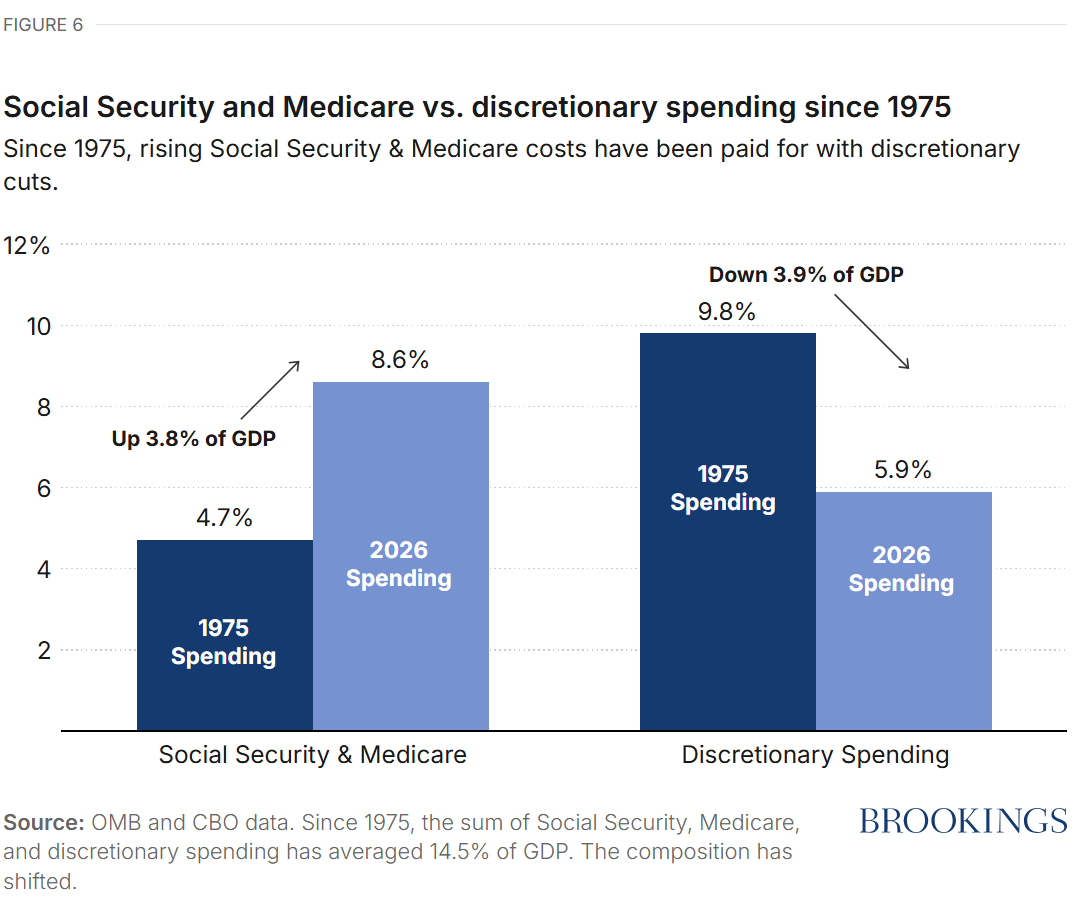
Just as Social Security and Medicare shortfalls threaten to consume nearly all potential tax increases, they are already squeezing other spending priorities. Between 1975 and 2026, Social Security and Medicare spending rose by 3.8% of GDP—and discretionary spending accordingly fell by 3.9% of GDP. This represents a 40% decline in spending as a share of the economy for a category that includes defense, veterans’ health care, K-12 education, health research, housing, foreign aid, economic development, disaster relief, the environment, Head Start, childcare, and infrastructure.39
This shift in federal resources has been purposeful. Between 1983 and 2011, rising budget deficits induced Congress and the White House to enact six major deficit reduction laws. Even though these rising deficits were heavily driven by rising mandatory spending costs, lawmakers concentrated the majority of budget savings across these six laws within discretionary spending. Even as discretionary spending’s share of federal spending fell, lawmakers continued to slash $3 in discretionary spending for every $1 cut from mandatory spending. Politically, the constituencies for discretionary spending programs were no match for advocates of Social Security, Medicare, and other mandatory programs.40
This funding shift is likely to continue. In the bipartisan negotiations leading to the 2023 Fiscal Responsibility Act, discretionary spending limits once again proved more popular with lawmakers than reining in surging mandatory costs. And over the next three decades, as Social Security and Medicare shortfalls worsen, the remaining 3.2% of GDP in non-defense discretionary spending is likely to be further carved up by lawmakers seeking to avoid the difficult decisions on Social Security, Medicare, and taxes.
Defense spending, which has already fallen from 6.0 to 2.8% of the economy since the mid-1980s to its lowest level since the 1930s, is also likely to continue getting squeezed by these budget forces.41 Although global dangers are likely to put a floor on defense spending, surely well above NATO’s traditional minimum target of 2% of GDP, which may push deeper cuts to the domestic discretionary programs
Prioritizing seniors over kids and poverty relief
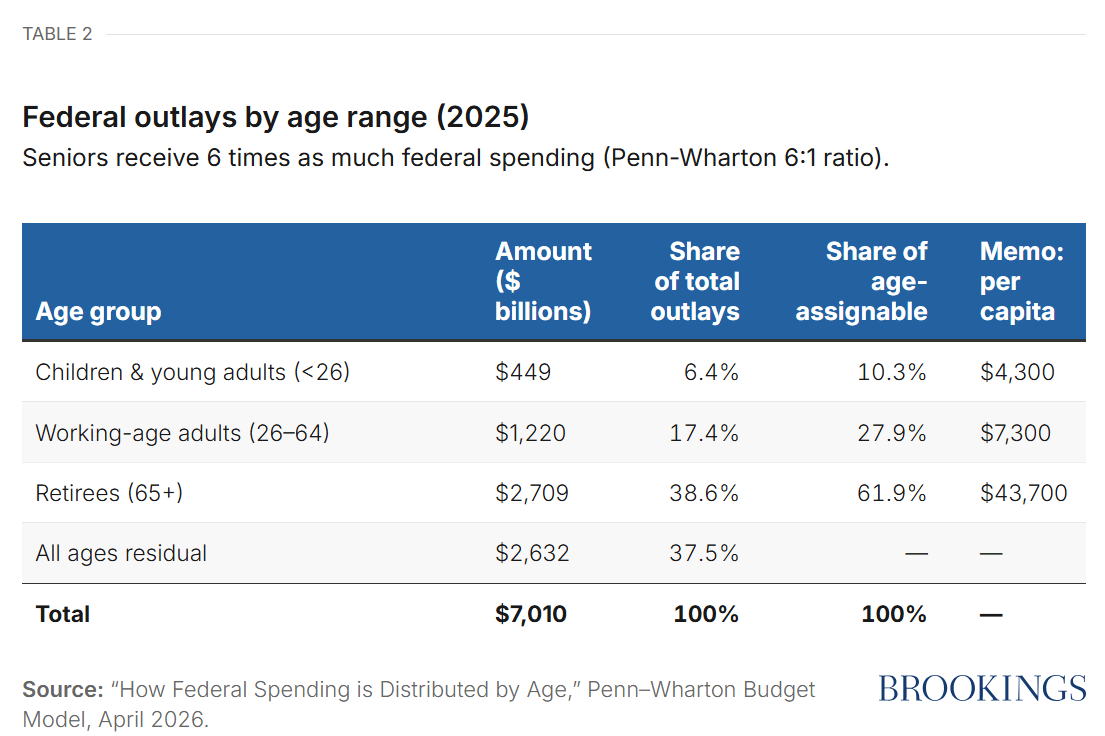
While budgets are financial documents, it is often remarked that the federal budget is also an expression of priorities. In that case, the federal government prioritizes often wealthy seniors far more than any other population or budget function. According to economists at the Penn-Wharton Budget Model, the federal government in 2025 spent $2.7 trillion on benefits for senior citizens—versus just under $450 billion spent on children and young adults (ages 25 and under), and $1.2 trillion on working-age adults (ages 26-64). In other words, the federal government spends $6 on seniors for every $1 on children and young adults.42 On a per-capita basis, the spending ratio soars to 10:1, with the federal government spending $43,700 per retiree versus $4,300 per child and young adult (and $7,300 per working-age adult). Given the aforementioned wealth and high incomes of many seniors, as well as the substantial individual and economic benefits of investing in children, few would consider this an optimal or even justifiable allocation of government resources.
And this ratio is set to expand significantly over the next three decades as Social Security and Medicare costs continue to deepen. This will further squeeze every other federal budget priority, including children, college students, working families, national security, and infrastructure. These costs also threaten to impose painful taxes on working families, many of whom will never see the benefits themselves. As is often said in economic policy circles, the federal government may eventually be best described as a senior pension and health system with an army.
This outcome is no accident. Rather, it is the predictable outcome of a budget process that provides Social Security and Medicare with the first claim on tax dollars—as is provided by their mandatory funding status with a faux-“trust fund” structure—and then forces children, poor families, schools, medical researchers, veterans, and the climate to fight for the remaining scraps of funding in the annual appropriations process.
The progressive response to escalating senior benefits has long been to assert that simply taxing the rich and streamlining defense can provide enough fiscal space to fully fund all priorities, from seniors to working families to children. The past 50 years have demonstrated the folly of such thinking. Even unified Democratic governments have been unwilling to enact such exorbitant tax increases on corporations and wealthy families, which nonetheless would still be insufficient to finance the stratospheric cost of this spending agenda. And with middle-class voters also resistant to Europe-sized tax increases, growing senior costs have instead been funded by a combination of budget deficits and cuts to social programs. It is naïve to continue providing Social Security and Medicare with this budgetary blank check on the hope that future lawmakers will enact some virtually unprecedented (and still mathematically insufficient) package of tax increases that closes the Social Security and Medicare gap as well as fully finances kids, working families, education, climate, infrastructure, and all other priorities.
Instead, it is necessary to recognize the limits of federal spending and the trade-offs they bring. The federal government is allocating an alarming share of federal spending to often-wealthy seniors that will continue to squeeze investments in children and working families. When parents over-extend themselves with unaffordable financial commitments, the proper response is to unwind those commitments. It is not to indulge themselves and then pass a suffocating financial burden on their children. Yet, collectively as a nation, America seems to be choosing that latter path when it refuses to revisit its Social Security and Medicare commitments even for financially comfortable seniors.
Part 2: The case for progressively reforming benefits for financially comfortable seniors
This portion of the report shows that senior income has dramatically increased over the past few decades, including a breakaway share of seniors who are quite wealthy. Reforming benefits slightly for middle-income seniors and more notably for high-earning seniors can reduce Social Security and Medicare shortfalls and limit the burden of new taxes and social spending reductions for working families.
Today’s seniors are largely financially secure
When President Franklin Roosevelt signed into law the Social Security Act of 1935, an estimated half of older Americans were poor or unable to support themselves as a result of the Great Depression combined with a long-standing lack of pensions, savings, and jobs for the oldest Americans.43 And for nearly a century, Social Security has been extraordinarily successful at reducing senior poverty, allowing older Americans to retire with dignity, and limiting the financial care-taking burden of their children.
However, the financial state of the elderly has drastically improved over the past 90 years—and not just because of Social Security (and Medicare) benefits. Lifetime incomes have surged, retirement savings and pension programs have grown widespread, and homeownership has provided substantial home equity and for many a conclusion of monthly mortgage payments. With older Americans now controlling most of the country’s wealth, it makes sense to revisit the Depression-era structure of Social Security benefits, and the 1960s-era structure of Medicare benefits.
Senior poverty is low. In examining Social Security and retiree incomes, we can start with the best news. By the official poverty measure, just 9.9% of Americans 65 and older were poor in 2024—below the 14.3% rate for children and about even with the 9.6% rate for working-age adults.44 And adjusting for the retirement income that household surveys undercount, the cash-income senior poverty rate falls further, to roughly 6 to 7%.45 While retirement experts suggest aiming to replace 70% to 80% of one’s annual earnings in retirement, the poorest one-fifth of seniors see Social Security replace an average of 78% of their income while also retaining eligibility for other anti-poverty assistance.46
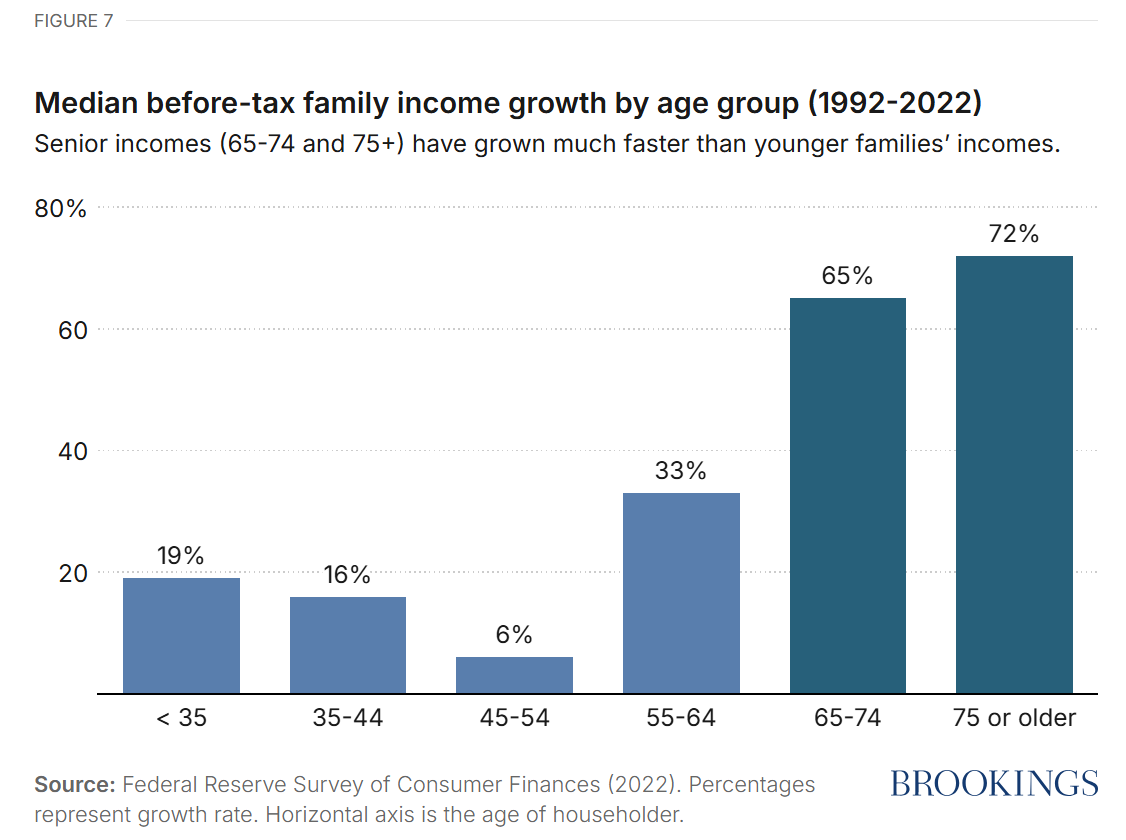
Senior incomes are healthy. For the past three decades, senior incomes have grown significantly faster than for younger families. The Federal Reserve reports that, between 1992 and 2022, median household income (after inflation) leaped by 65% for 65–74-year-olds, and 72% for those 75 and older—dwarfing the 33% income growth for the 55–64-year-olds, and the sub-20% growth for all younger age groups (see Figure 7).47 Another study of household income growth between 1980 and 2018 found that the middle-earning quintile of seniors had enjoyed a cumulative 60% income growth, and the lowest-earning senior quintile had seen 30% income growth—compared to 15% growth for workers (all adjusted for inflation).48
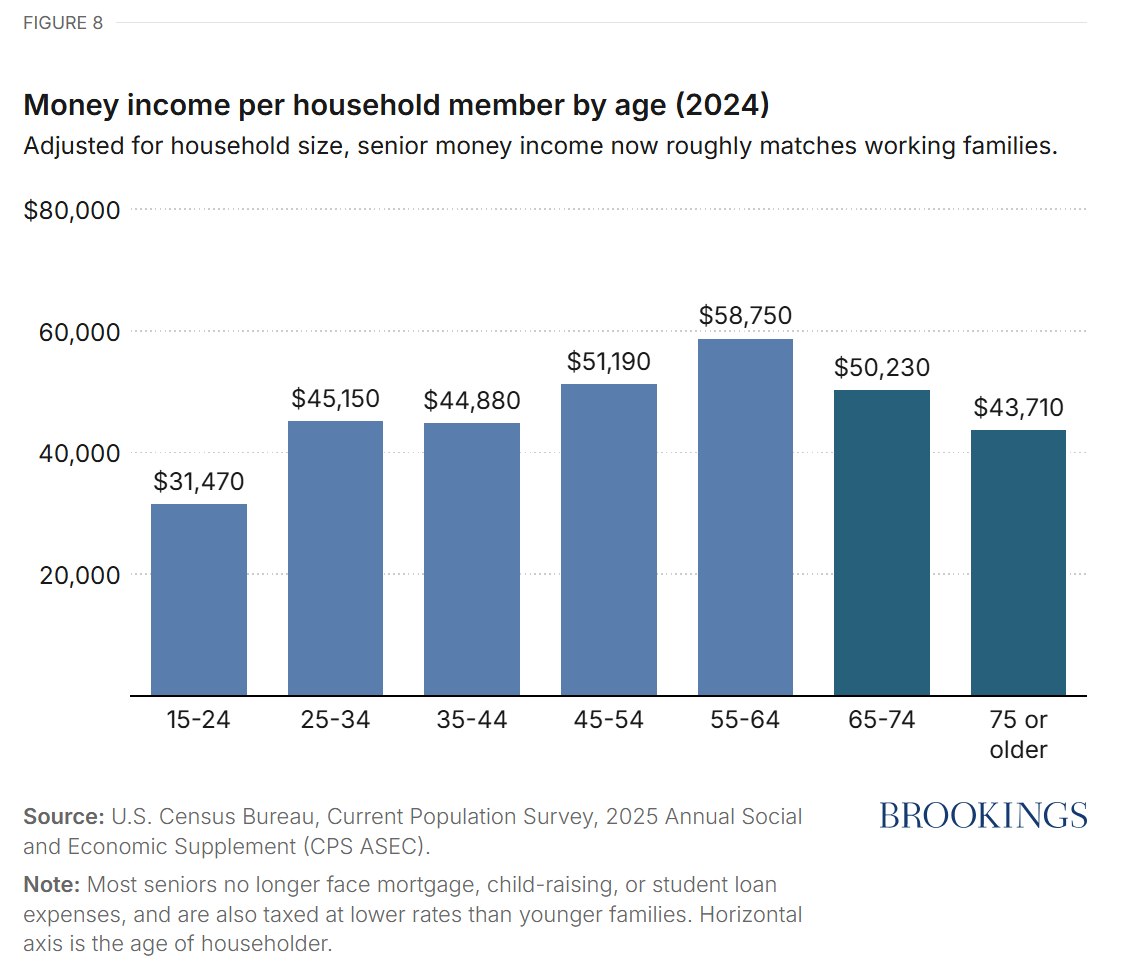
Lower expenses, less debt. The median household income for working-age families still exceeds that of seniors. Yet when adjusting for family size (such as the number of children), the income gap between working-age families and retirees mostly disappears. The Census Bureau reports that income-per-household-member for seniors ($47,610) nearly matches that of working age families ($48,540)—including exceeding it for families headed by someone under age 45 (see Figure 8).49
More broadly, adjusting for reduced expenses in key areas shows most seniors living more comfortably than typical younger families. Most seniors no longer face child raising costs, or student loan expenses that can burden younger families. Most retirees also no longer feel pressure to set aside 5 to 10% of their earnings for future retirement, and many pay lower effective tax rates than younger workers because Social Security benefits do not face payroll taxes or full income taxes.
While nearly 80% of seniors are homeowners,50 only one-third have any remaining mortgage debt, and roughly 40% report carrying no debt of any kind (not even a credit card balance).51 Overall, Americans 65 and older have by far the lowest debt with a total leverage ratio of around 4%.52 Americans age 60 and older are also the least likely age group to report having trouble paying their bills or affording food.53 The often-dramatic reduction in leading household expenses such as mortgage payments, child-raising, student loans, and retirement savings can provide a comfortable lifestyle even with modestly reduced incomes after retirement.
Many wealthy seniors. The prosperity of middle- and lower-earning seniors reflects the success of the Social Security system. Yet approximately one-third of senior households are doing remarkably well financially. According to the Census Bureau, there are more senior-headed households earning at least $100,000 annually (11.0 million) than there are those earning under $30,000 (10.7 million)54—and even that understates the number above $100,000 by undercounting income from retirement distributions and capital gains.55 In fact, 3.5 million senior households are earning more than $200,000 annually even with the aforementioned undercounting.56 To the extent that such post-retirement incomes are based on capital gains, annuities, and retirement distributions, they suggest investment values in the millions of dollars.
Nor are healthy senior incomes merely a function of Social Security benefits themselves. In 2026, an estimated 12.8 million individual seniors live in households with incomes over $100,000 before counting any Social Security—including 4.7 million individual seniors above $200,000.57
Thus, not surprisingly, for the population of individuals between the ages of 65 and 74, median household net worth exceeds $400,000, and an average household net worth approaches $1.8 million, with the latter figure driven upwards by a subset of very wealthy seniors.58 The Federal Reserve finds that Americans 55 and older own roughly three-quarters of the nation’s wealth—including nearly one-third owned by individuals age 70 or older.59
Seniors report more financial comfort than working-age families. A strong majority of seniors feel financially sound. When the Federal Reserve surveyed seniors about their personal financial situations, only 3% reported “finding it difficult to get by,” while 12% were “just getting by” and 86% were “doing okay” or “living comfortably.”60 A separate Federal Reserve survey, the Survey of Consumer Finances, found that more than three-quarters of 65-to-74-year-olds—77%—reported they could at least maintain their pre-retirement standard of living, up from 61% in 1992.61 Other surveys showed that most seniors are “pleasantly surprised” by their standard of living in retirement, only one-fifth report doing “worse than expected” financially, and 80% describe themselves as living comfortably.62
In fact, many senior-led households are now more financially comfortable than working-age families. The Federal Reserve’s SHED data showed Americans ages 60 and over reporting the highest level of financial well-being of any age group—that is, the largest share saying they were at least “doing okay” financially.63
To be sure, many seniors continue to struggle financially, particularly those without the full work histories necessary to earn more comfortable benefits. However, with the help of Social Security and Medicare, most seniors are quite comfortable financially, and millions of retirees are substantially wealthy. This good news provides an opportunity to reassess Social Security and Medicare’s distribution of benefits.
Social Security and Medicare now often redistribute income upward
The rising incomes and wealth of retirees—and especially the emerging subset of extraordinarily wealthy retirees—presents an opportunity to revisit the substantial Social Security and Medicare benefits paid to those who may not need much federal assistance. Indeed, with these programs’ trust funds headed toward insolvency and budget deficits growing to unsustainable levels, protecting these programs’ ability to pay full benefits to low-income seniors will likely require recalibrating benefit levels for a newer subset of wealthier seniors who enjoy large post-retirement incomes as well as net worths that often reach millions of dollars.
Today’s wealthy seniors are the wealthiest members of the wealthiest generation in the wealthiest nation in world history. And yet, the federal government not only pays the highest earners full Social Security benefits, it pays many of them the largest benefits in the history of the system—more than low-earners, and more than past generations’ high earners (adjusted for inflation).
Larger benefits for high earners. Social Security benefits are progressive in that the annual benefit formula replaces a larger share of prior earnings for lower earners than for higher earners.
However, because of longer work history and higher lifetime earnings, Social Security still provides larger benefits to higher earners than to lower earners. Such a policy makes sense through the lens of Social Security as a pension-style system that ties contributions to benefits. Yet through a poverty-relief lens, this could be considered an expensive misallocation of scarce federal tax dollars.
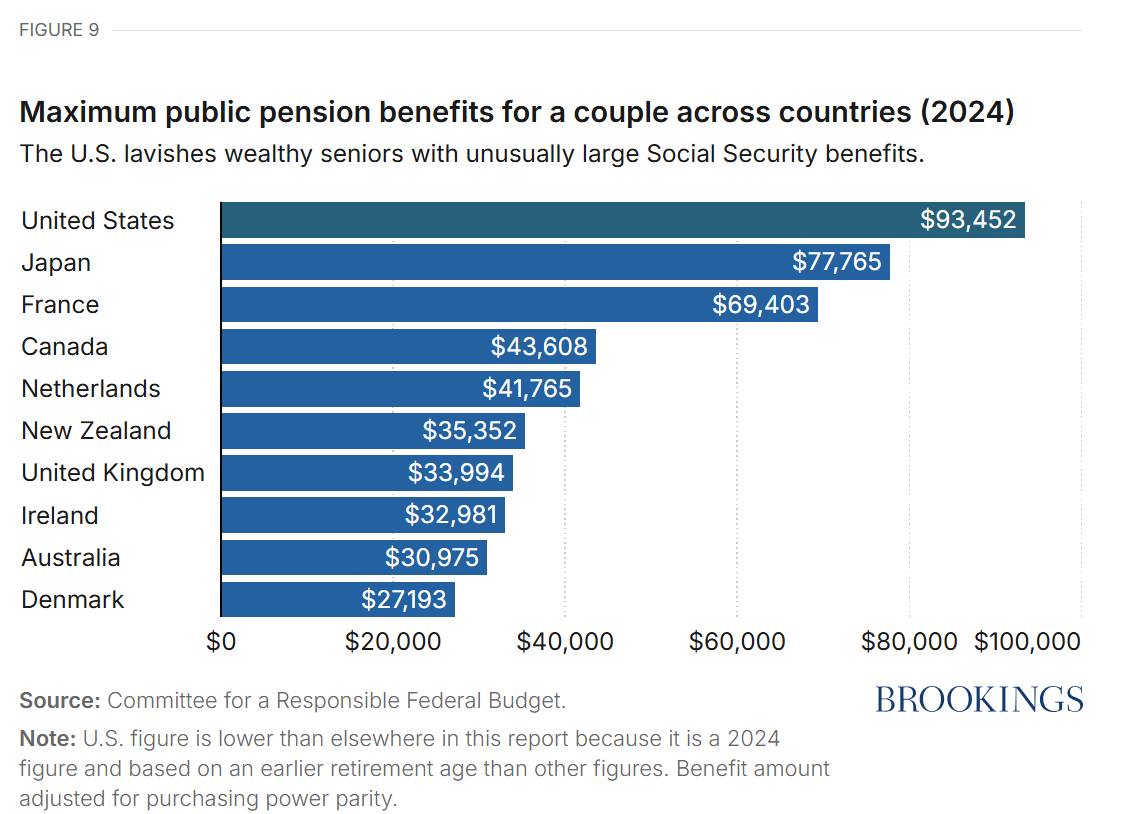
U.S. high earner benefits far exceed other nations. While America’s Social Security benefits for middle- and low-earners broadly align with international norms,64 its benefits for high-earners far exceed most other nations. The Committee for a Responsible Federal Budget compared the United States Social Security system to nine other high-income countries’ public pension systems. It showed the United States offering a maximum benefit that exceeds every other nation, and in most cases dramatically. Adjusted for purchasing power parity, a top-earning married couple in 2024 in the U.S. would receive $93,452 annually, versus $69,403 in France, $43,608 in Canada, $33,994 in the United Kingdom, and $30,975 in Australia (see Figure 9).65 These higher benefits are largely a function of the United States assessing payroll taxes higher up the wage ladder than many other nations, which undermines the argument that the U.S. is unique in capping the wages that apply to Social Security taxes.
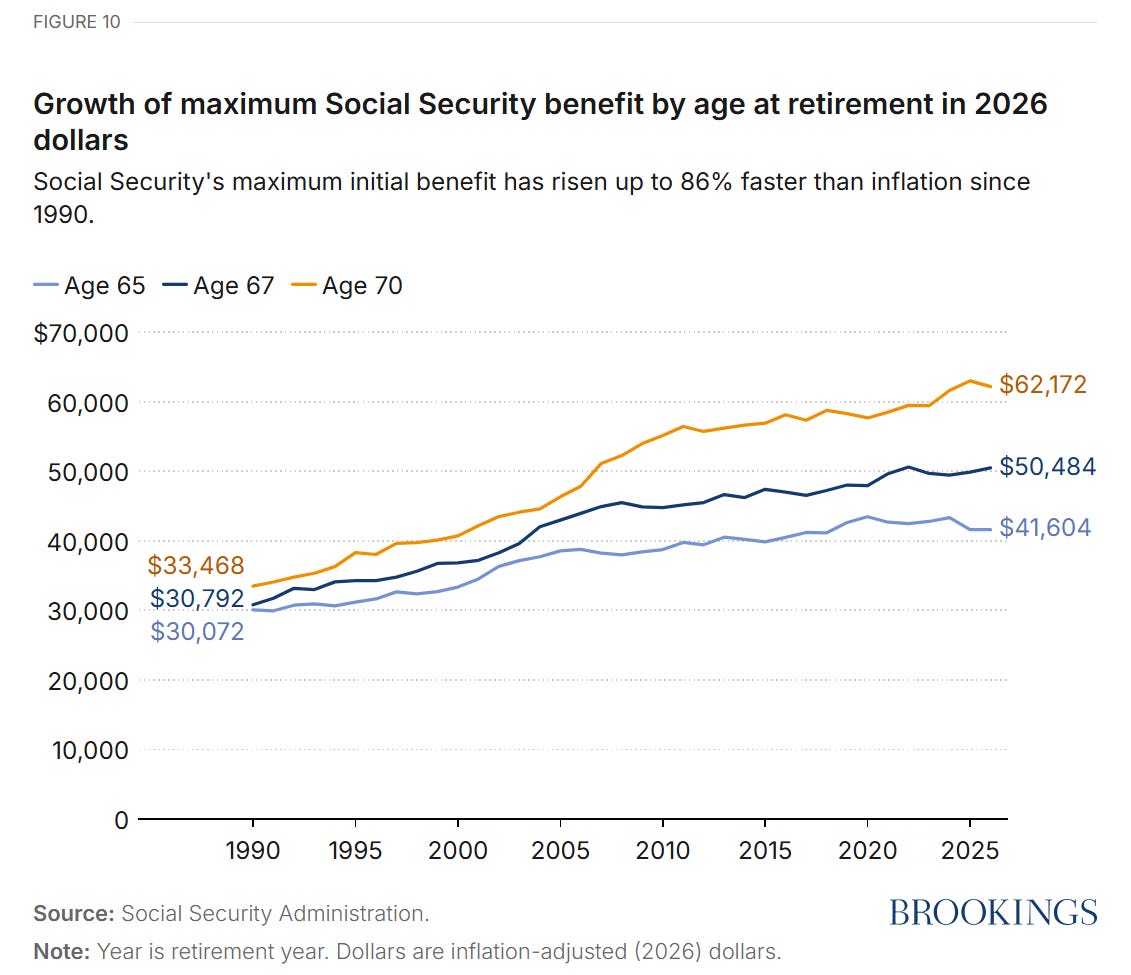
Benefits become more generous for each successive generation. High earners benefit from this broad dynamic as well. Because Social Security computes initial benefits by converting a worker’s lifetime earnings into current dollars using a wage-based index that typically rises faster than prices—and because the formula’s bend points are themselves wage-indexed—each new cohort’s initial benefit grows faster than inflation.66 Only after that initial benefit is set does it switch to growing with prices, through the annual cost-of-living adjustment. Thus, the Urban Institute calculates that the initial Social Security benefit for an average-earning married couple retiring at age 65 was $40,900 if they retired in 1990. If they were born 35 years later, they retired in 2025 with an initial benefit of $51,900. And the next generation of average-earning married couples retiring in 2050 are scheduled to receive an initial benefit of $70,600—with all figures adjusted for inflation into 2025 dollars.67 In 2026, the highest-earning couples could theoretically retire at age 70 with a combined initial benefit of $124,344—an inflation-adjusted increase of 86% since 1990 (see Figure 10).68
Higher earners typically collect benefits for more years. Additional factors benefit wealthy seniors. Annual benefit snapshots fail to account for higher-income Americans living substantially longer than lower-income Americans—a longevity gap that has been widening for decades.69 Consequently, typical higher earners draw full benefits for several more years than lower earners, and this divergence has grown large enough to erode the progressivity that is built into the benefit formulas.70 The same dynamic works through Medicare, where longer-lived, higher-income beneficiaries accumulate more years of taxpayer-subsidized coverage (undoing some of the progressivity of higher Part B and D premiums for the richest retirees). In short, a program structure that looks progressive on an annual basis delivers a notably less progressive stream of benefits once unequal lifespans are taken into account.71
Social Security’s spousal and survivor benefits compound this tilt. A spouse can collect up to 50% of a worker’s benefit while both are alive, and up to 100% as a survivor, with no additional payroll taxes paid. Because that top-up is a share of the breadwinner’s benefit, it is largest for the spouses of high earners—and it rewards single-earner couples over two-earner couples with identical total earnings, since a working spouse’s own benefit offsets the spousal amount.72
Medicare subsidies contribute too. Very wealthy retirees may also receive taxpayer-funded premium subsidies for their Medicare Part B (physician care) and Part D (prescription drug coverage) insurance plans. These Medicare Parts B and D subsidies are not social insurance benefits that are earned with earlier payroll taxes (which contribute only to future Social Security and Medicare Part A benefits). They are a government subsidy and handout in a manner not dissimilar to Medicaid or ACA exchange subsidies. Yet they are extended even to millionaires, albeit at levels that begin declining at incomes above $218,000 for married couples.73
Result: large benefits for rich retirees. Consequently, a married couple with dual-high incomes could retire today with an initial combined Social Security benefit of more than $100,000 and receive taxpayer subsidies for Medicare Parts B and D assistance that was never earned with prior payroll taxes. High-earning seniors are not highly reliant on Social Security benefits for their income. Congressional Budget Office data shows that Social Security payments comprise 87% of the income for the bottom-earning senior quintile, and 68% for the second-lowest quintile—but only 8.5% of the income for the highest-earning senior quintile. While the top quintile is skewed by the richest 1% receiving only 1.2% of its income from this program, Social Security’s income shares average 19% for the 81st to 90th income percentile, 13% for the 91st to 95th percentile, and 8% for the 96th to 99th income percentile.74 And yet, those relatively minor income supplements for the wealthiest seniors will continue to bring substantial fiscal costs.
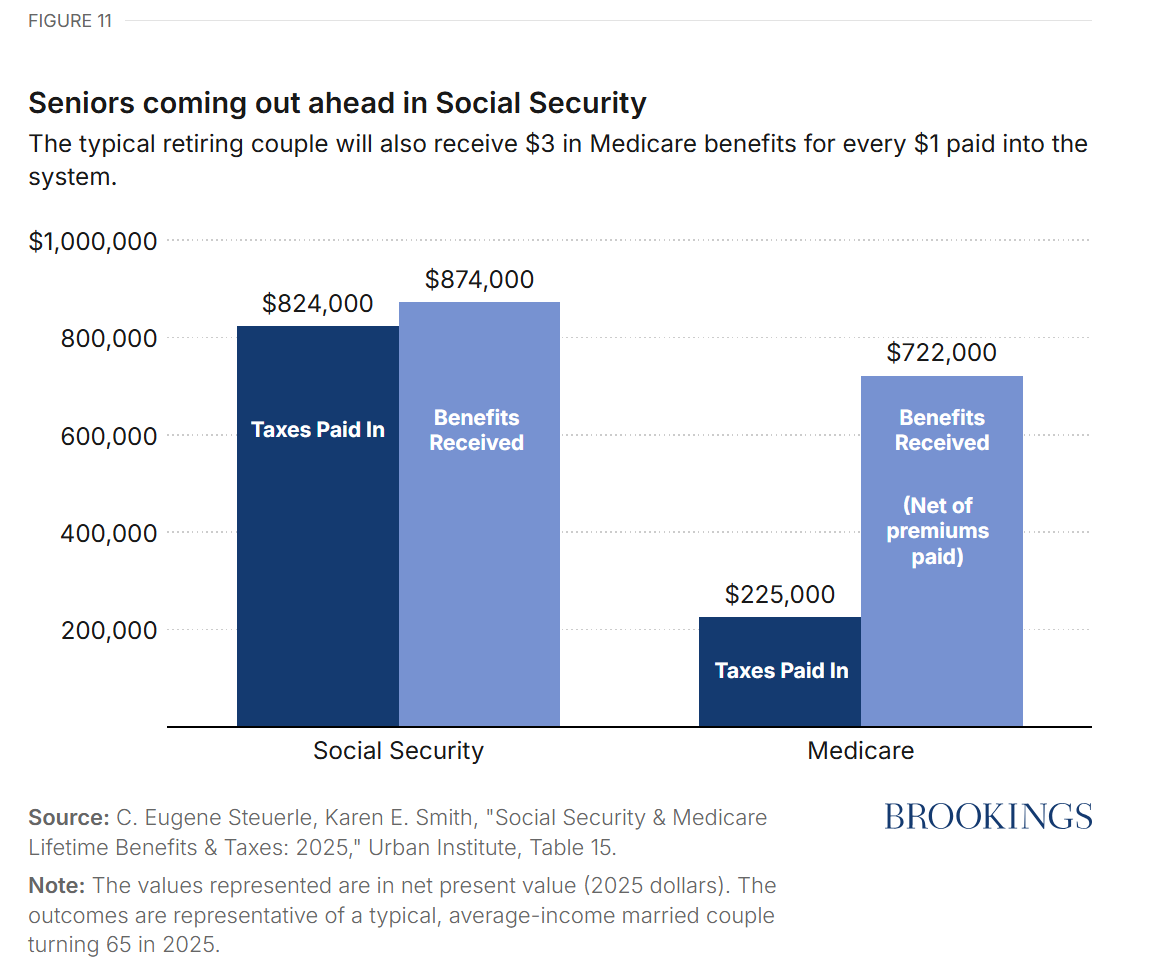
Lifetime contributions versus benefits. A common argument posits that reforming Social Security and Medicare benefits would rob seniors of their lifetime contributions by returning less than that amount in benefits. However, Eugene Steuerle and Karen Smith of the Urban Institute calculate that a married couple with two average-earners turning 65 in 2025 will likely total $824,000 in lifetime Social Security taxes versus $874,000 in benefits—with both figures adjusted into net present value (see Figure 11). Medicare is even more slanted, with this typical couple paying $225,000 in lifetime Medicare taxes and receiving back $722,000 in Medicare benefits net of premiums paid (also in net present value). Higher earners are more likely to receive lifetime Social Security benefits that fall short of their lifetime taxes in present-value terms; even so, many come out far enough ahead on Medicare to offset that Social Security shortfall.75
Result: $5.6 trillion for wealthier retirees
In 2026, Washington is spending an estimated $322 billion on Social Security benefits for households with pre-Social Security earnings over $100,000 annually—on its way to a projected $530 billion annually within a decade (inflation-adjusting the $100,000 threshold). In total, over the next decade, these retirees will receive $4.3 trillion in Social Security benefits.76
Limiting the analysis to households earning more than $200,000 today in pre-Social Security income (adjusted for inflation moving forward), the federal government in 2026 is spending $121 billion on Social Security benefits and will spend $1.6 trillion over the next decade. Keep in mind that these families’ high post-retirement incomes are often the result of slowly drawing down substantial retirement and investment accounts, and that most seniors no longer face mortgage, student loan, or child-raising costs.
Most of these families also receive Medicare Parts B and D subsidies. Although federal Medicare B and D subsidies begin declining at family incomes over $109,000 (single) or $218,000 (married filing jointly), Washington will spend $1.2 trillion over the next decade subsidizing the premiums of families earning over $100,000 (adjusted for inflation), including $380 billion for families earning over $200,000. Remember that this is not social insurance—Medicare Part B and D benefits were not earned with earlier payroll taxes. It’s a pure government subsidy to high earners that will cost $163 billion annually by 2036.
Add it up, and Washington is set to spend $5.6 trillion over the next decade on Social Security and Medicare B and D benefits for families earning more than $100,000 before receiving any benefits. This includes $2.0 trillion for senior households that are continuing to earn at least $200,000 annually before receiving benefits.
If we broaden the income thresholds to include the Social Security income itself, Washington will spend $11.6 trillion over the next decade on households earning over $100,000 (adjusted for inflation) including $3.6 trillion for those earning over $200,000 annually after inflation. While the Social Security benefits may be major contributors to these incomes, many of the families may be able to afford a modestly smaller benefit.
Allocating trillions of dollars in subsidies to financially comfortable (and even highly wealthy) seniors would be a questionable allocation of tax dollars even within a balanced federal budget. Doing so in an era of unsustainable budget deficits is an unaffordable luxury that threatens to drive up middle-class taxes and force cuts to other progressive spending priorities. Social Security and Medicare continue to achieve their goals of keeping all but a small percentage of middle- and lower-earning retirees out of poverty. However, surging wealth, savings, and retirement accounts have produced a class of wealthier retirees that the architects of the New Deal and Great Society did not necessarily envision. While the solution is not to eliminate Social Security or Medicare benefits even for wealthy individuals who paid into these systems during their working years, preserving low-income benefits may require revisiting benefit levels for those wealthy enough to afford fewer benefits.
And as the next sections show, a refusal to revisit these expensive benefits will force other fiscal sacrifices that set back other progressive goals aimed at supporting working families.
Part 3: Reforms primarily affecting wealthier seniors
It is not likely feasible for Social Security and Medicare reforms to close the entire $157 trillion fiscal gap projected for these two systems over the next three decades. However, reforming benefits in ways that are affordable for more financially comfortable seniors can reduce the burden of additional taxes or other spending reductions for working families. While a full package of reforms may also modestly affect median-earning seniors who can afford them, this part focuses on reforms for higher-earning seniors.
Progressive principles for reform
Policymakers have a choice. They can continue to oppose all Social Security and Medicare benefit reforms—to maintain these programs’ first claim on federal taxes regardless of how much they cost—and thus condemn American workers and families to substantially higher lifetime tax burdens along with continued reductions in pre-retirement government benefits. Or they can open the door to reforming Social Security and Medicare to prevent these two programs from devouring the federal budget and other fiscal priorities.
This trade-off cannot be averted simply by taxing the rich, cutting defense spending, and/or imposing Medicare-for-all. Ultimately, bringing the federal budget into long-term sustainability will require a broad combination of Social Security and Medicare reforms, new taxes, and other programmatic savings. But mathematical reality dictates that most of those savings almost certainly must come from Social Security and Medicare themselves, given their 30-year shortfall of $83 trillion (plus $74 trillion in interest);77 it is simply not feasible to plug a fiscal hole of this magnitude with other tax increases or spending cuts, especially if other progressive priorities also require new funding.
Such reforms are possible within a progressive framework, along the following guidelines:
Prioritize poverty relief and aid to low-income seniors. The primary role of social insurance is to protect individuals from the threat of poverty—a goal that is easily affordable. It need not also take on the unsustainable cost of serving as a national annuity, in which even wealthy seniors receive Social Security and Medicare benefits that well exceed their combined contributions, even after a net-present-value adjustment. After all, auto insurance compensates the victims of accidents; it does not guarantee every policyholder a subsidy exceeding their premium, regardless of whether they had an accident. Health insurers do not fully refund the premiums of the healthy, and homeowner’s insurance does not subsidize policyholders who suffered no losses—because doing so would not be actuarially sustainable.
Trim benefits for high earners. Prioritizing poverty relief does not entail eliminating benefits for the non-poor. Workers who paid payroll taxes to Social Security and Medicare throughout their entire working career—and who built their retirement strategies on the assumption of future benefits—are morally entitled to some level of retirement benefits. But Social Security and Medicare were designed in eras when most seniors were poorer and had far less access to workplace pensions, retirement savings plans, and personal savings. Over the past several decades, benefits have grown dramatically for a subset of seniors who are now substantially wealthier than most of the taxpayers financing those benefits. Preserving Social Security and Medicare’s ability to serve lower earners will require moderately trimming benefit levels for wealthier seniors who can afford it.
Prioritize generational fairness. Critics of Social Security and Medicare reform often describe these programs as an inviolable intergenerational pact. Yet an equitable intergenerational pact must be fair to all affected generations—not just the one currently receiving benefits. The pact is meant to ensure that those who contribute to Social Security and Medicare will receive some retirement benefits and be protected from poverty in old age. It does not mean that benefits should be repeatedly expanded far beyond a typical family’s lifetime contributions, with those benefits always retaining the first claim on federal tax dollars. It does not mean that working families and their children should be saddled with exorbitant tax increases and sharply reduced benefits to close a 30-year Social Security and Medicare shortfall of $157 trillion (including interest). And it does not mean raising taxes on a family earning $40,000 annually so that a retired couple earning $200,000 can have their Part B and Part D premiums subsidized—a benefit never “earned” through prior payroll taxes. There is nothing “generationally fair” about the federal government spending six times as much on senior citizens as on those age 25 and younger.
Current seniors cannot be grandfathered out of reform. In the 1990s and early 2000s, policymakers routinely asserted that Social Security and Medicare reforms should affect only those under age 50 (or sometimes 55) at the time of enactment, guaranteeing ample time to adjust their retirement plans. That option was available at that time because the first baby boomers would not reach Social Security’s early retirement age of 62 until 2008, meaning that most of this expensive generation would ultimately be included in the reforms. Lawmakers missed that window, and grandfathering out everyone now at or near retirement age would mean exempting the 77 million baby boomers whose costs are driving the programs’ unsustainable shortfalls. Gradually phasing in reforms beginning in the early 2040s—as such an exemption would require—is simply too little, too late to avert these fiscal dangers. That constraint makes it even more important to concentrate Social Security and Medicare reforms on higher-earning seniors, who have the resources to absorb a reduction in benefits.
Support retirement savings. The mathematical reality is that the federal government has promised more Social Security and Medicare benefits than the long-term economy can finance at the tax rates working families expect. While lawmakers should concentrate most savings on wealthier seniors who can afford modestly smaller benefits, today’s workers would be wise to build enough retirement savings to absorb a potential reduction in benefit levels. To that end, lawmakers should continue to support retirement incentives—enhancing the Saver’s Credit that partially matches low-income workers’ private retirement contributions, making it easier for workers to enroll in and escalate their contributions to workplace retirement plans, and keeping defined-benefit plans solvent. For those who need to keep working later in life, the federal government could eliminate Social Security payroll taxes beginning at age 62, which would both encourage employers to hire such workers and boost the workers’ own take-home pay.78
Do not fear that high-earner benefit reductions will destroy political support. Champions of Social Security and Medicare often express understandable fear that any reduction in benefits to high earners will undermine the political support that maintains these systems. This view has historically been summed up with the slogan that “a program for the poor is a poor program.” While this adage would warn against eliminating high-income Social Security and Medicare benefits, asserting that such benefits cannot even be trimmed is a non sequitur. After all, the programs and their benefits would remain universal, and this universal participation drives the system’s political durability.
The premise that any high-earner benefit cuts are politically fatal is already falsified. Social Security’s formula is progressive, benefits are taxed for higher earners, and Medicare charges income-related premiums (IRMAA). These top-end trims were enacted decades ago and did nothing to erode support. Moreover, the pivotal political coalition is the middle class, not the top 10%—who in any case would be just as offended by eliminating the payroll tax cap (with no corresponding benefit credit) as by trimming their eventual benefits. Maintaining universal support for Social Security and Medicare is important, yet it does not require spending trillions of dollars over the next decade to ensure that the wealthiest seniors can receive annual benefits as high as $100,000 per couple.
Potential policies affecting high-earning retirees
Before moving from principles to specific policies, two caveats are in order. First, the savings from these recommendations cannot simply be summed together, because their effects overlap—several would apply to the same scheduled benefits for the same individuals. Second, this list includes only those Social Security and Medicare reforms that primarily or exclusively affect high earners; as such, they are not sufficient to close the entire Social Security and Medicare funding shortfalls on their own. Additional savings from health care reform, higher eligibility ages, broad benefit reforms, and higher taxes would all be necessary to accomplish that.79 Nonetheless, aggressively reforming benefits for higher earners—who can most afford those reforms—can substantially reduce the cost of reform borne by lower-earning retirees.
Policies that include current high-earning retirees
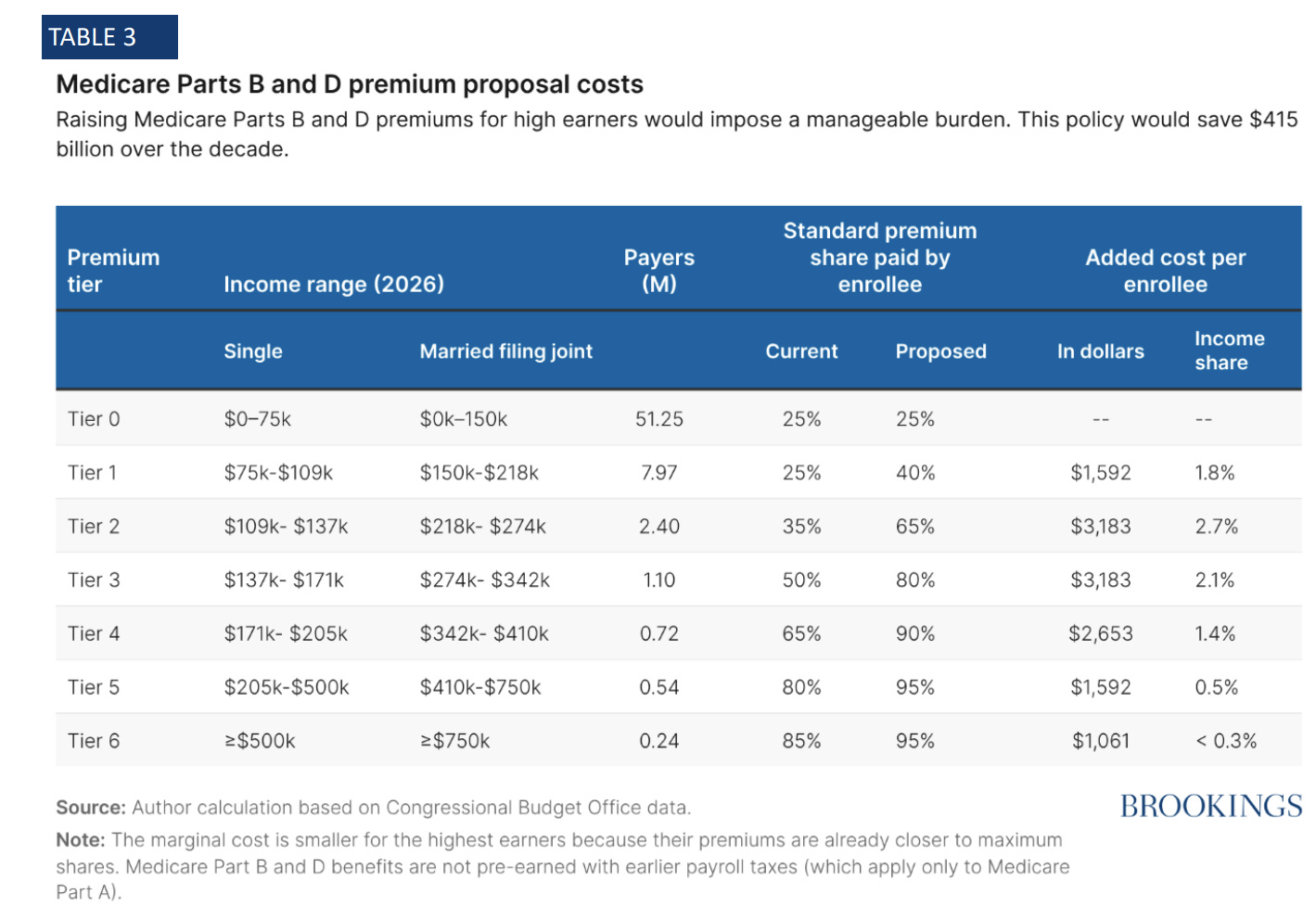
Raise Medicare Part B and D premiums for high earners. Because Part B and D benefits are not “earned” through payroll taxes, it is not clear why high earners should receive substantial premium subsidies. Lawmakers could raise the basic premium from 25% of the cost of coverage to 40% for individuals earning $75,000 (single) or $150,000 (married). For higher earners already paying premiums of between 35 and 85% of coverage costs, lawmakers could raise those shares to between 65 and 95%, following the schedule in Table 3. The maximum added cost would be less than $3,200 per enrollee, yet the ten-year savings would total approximately $415 billion.80
Eliminate the Social Security COLA for high earners. Lawmakers could deny the annual cost-of-living adjustment to Social Security recipients whose household income in the prior year exceeded $100,000 (single) or $200,000 (married), with the income thresholds themselves rising annually with inflation. This policy would save approximately $470 billion in its first decade, and because the savings grow over time, would eliminate more than 25% of Social Security’s projected annual shortfall by 2056.81
Cap Social Security benefits at $100,000 per couple. The Committee for a Responsible Federal Budget (CRFB) has proposed capping the total benefits a couple retiring at the normal retirement age can receive at $100,000, with a corresponding $50,000 cap for a single retiree. Freezing the cap at these levels for a decade would save $190 billion over ten years, while allowing it to rise annually with inflation would lower the savings to $100 billion. The savings would grow over time: even the inflation-indexed version would close one-fifth of Social Security’s 75-year shortfall, according to CRFB.82
Apply Medicare’s IRMAA principles to Social Security. Medicare currently charges higher Part B and D premiums to seniors with substantial post-retirement incomes. A parallel Social Security policy would scale back benefits for seniors with high post-retirement incomes. For example, reducing benefits by 15% for married couples with retirement incomes between $200,000 and $300,000, 30% for those between $300,000 and $500,000, 40% for those between $500,000 and $750,000, and 50% for those above $750,000 (the corresponding brackets for single filers are $100,000–$150,000, $150,000–$250,000, $250,000–$500,000, and above $500,000) would save nearly $700 billion over the decade.83
Make 100% of Social Security benefits taxable for high earners. Currently, up to 85% of Social Security benefits are subject to income tax for beneficiaries with incomes above $34,000 (single) or $44,000 (married). Lawmakers could instead tax 100% of benefits for singles earning $100,000 and couples earning about $125,000. According to Brookings Institution scholars Wendell Primus, Tara Watson, and Jack Smalligan, this policy would save approximately $250 billion over the decade.84
Policies affecting future high-earning retirees only
Reduce the top (15%) benefit factor to 5%. When calculating an individual’s initial Social Security benefit, lifetime wages are first converted into current dollars (using the more generous wage inflation rather than price inflation, as discussed earlier). That figure is then translated into an initial benefit through a formula that replaces 90% of the first $15,432 of annualized earnings, plus 32% of earnings between $15,432 and $92,988, plus 15% of any earnings above that (these thresholds are likewise adjusted annually for wage inflation).85 Reducing the top factor from 15% to 5% for future retirees would modestly pare back benefits for high earners. The first-decade savings would be very small, but by the end of the 30th year the policy would save approximately 0.17% of GDP—out of Social Security’s projected deficit of roughly 1.5% of GDP.86
Move to progressive price indexing for the highest-earning 40%. Building on the benefit calculation described above, lawmakers could convert lifetime wages into current dollars using price inflation rather than wage inflation—and index the earnings brackets by prices as well—for the highest-earning 40% of future retirees. Because prices generally rise more slowly than wages over the long run, this would yield a lower lifetime-earnings figure against which the benefit factors are applied. The initial savings would be small, since the policy reaches only a limited population of future retirees, but by the 30th year it is estimated to save 0.3% of GDP out of Social Security’s projected shortfall of 1.5% of GDP.87
Conclusion
It is tempting for progressives to keep opposing any reforms to Social Security and Medicare benefits. Such a stance is politically popular, and opening the door to benefit changes could endanger the benefits that low-income seniors rely on. But the growing costs of Social Security and Medicare have already squeezed discretionary spending, including progressive social programs. And it is nearly a mathematical certainty that fully guaranteeing almost $200 trillion in benefits over the next three decades will further crowd out spending on progressive social programs while imposing painful taxes on low- and middle-income families.88
Benefits for low earners must be protected. But progressive principles cannot explain why working families should be saddled with substantially higher lifetime taxes and fewer public benefits so that millions of wealthy seniors can collect Social Security and Medicare benefits that far exceed their lifetime contributions, even in present-value terms. Nor can progressive principles defend a federal government that spends roughly six times as much overall on seniors as on those under age 26—a ratio likely to keep rising.89
Yes, Social Security and Medicare represent a compact between generations, meant to ensure that seniors can live with dignity and free from poverty. But that compact was never meant to be a blank check for open-ended benefit expansions—least of all for seniors far wealthier than the working families financing their benefits. Those who pay into Social Security and Medicare over a lifetime are entitled to benefits; some of those benefits should nonetheless be modestly pared back, both to secure the system’s long-term sustainability and to prioritize the primary role of poverty relief. Enacting commonsense benefit reforms would reserve most future tax increases on working families to finance priorities that serve those families directly, including health care, education, and childcare.
CLICK HERE for full report (including appendices) at the Brookings Institution
Thank you, Jessica, for this incredible article!
Dear legislators,
Just do what you must so that people know what to expect.
We can't go on without a financial reckoning; and the earlier, the better.
Thanks.