

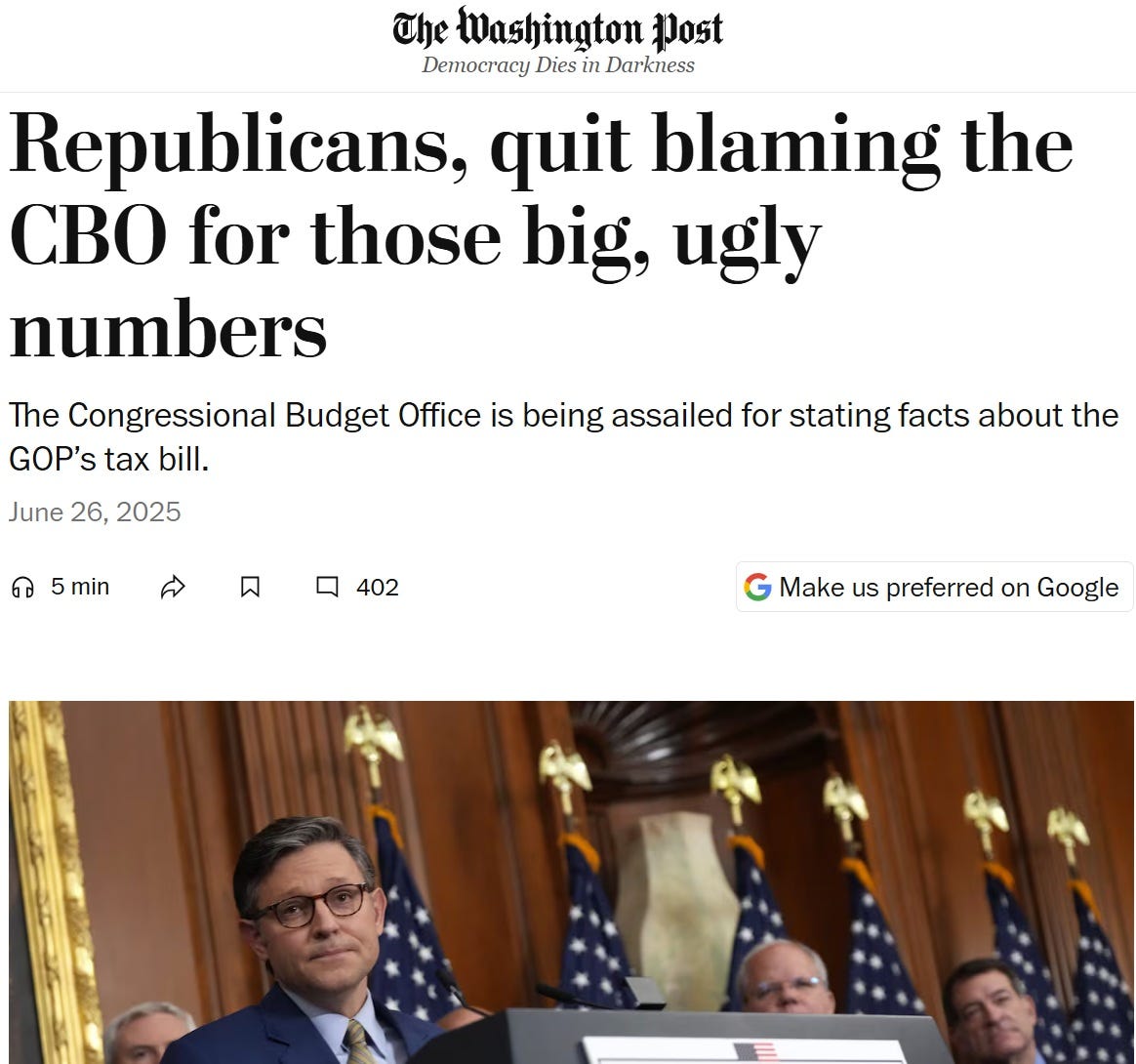
(Originally appeared in the Washington Post)
As Republican tax-cut legislation struggles to get through Congress under the weight of its staggering cost, party leaders have responded to criticism by trying to shift the blame. They’re assailing the nonpartisan Congressional Budget Office for the transgression of honestly describing the ugly $2.4 trillion reality of the One Big Beautiful Bill Act, as the legislation is titled.
GOP leaders have rallied around the talking point that the CBO’s egghead economists just don’t understand that tax cuts will unleash economic growth so stupendous that the additional tax revenue will offset the bill’s entire cost. What began with a May strategy memo from Newt Gingrich has grown to a chorus of condemnation of the CBO from congressional leaders, the White House press secretary and President Donald Trump.
Don’t fall for this spin. The CBO was created by Congress in 1974 as a counterweight to the White House’s Office of Management and Budget. Rather than having to rely on an often adversarial White House for budget estimates, Congress would have its own scoring body. The CBO is composed largely of nonpartisan economists and attorneys, with its director appointed by the party that controls Congress. Since 2019, it has been led by Phillip Swagel, a widely respected Republican economist.
The agency produces short- and long-term federal budget baselines, legislative cost estimates, and data-driven studies on fiscal and economic policy. More than being merely informative, the baselines and bill scores become the standard against which congressional anti-deficit rules are applied, such as the prohibition against reconciliation bills worsening long-term budget deficits.
To be sure, the CBO is not infallible. It erroneously assumed the late-1990s tax revenue bubble would continue indefinitely, creating unrealistic expectations of paying off the national debt. Its projections overestimated interest rates for decades before probably underestimating them now, which in turn lowballs future interest costs and budget deficits. Health care reform analyses have proved erroneous by overestimating the number of Americans who would gain health insurance under Democratic policies, as well as how many would become uninsured under GOP policies. Those CBO fumbles are surely fresh in the minds of many Republicans.