

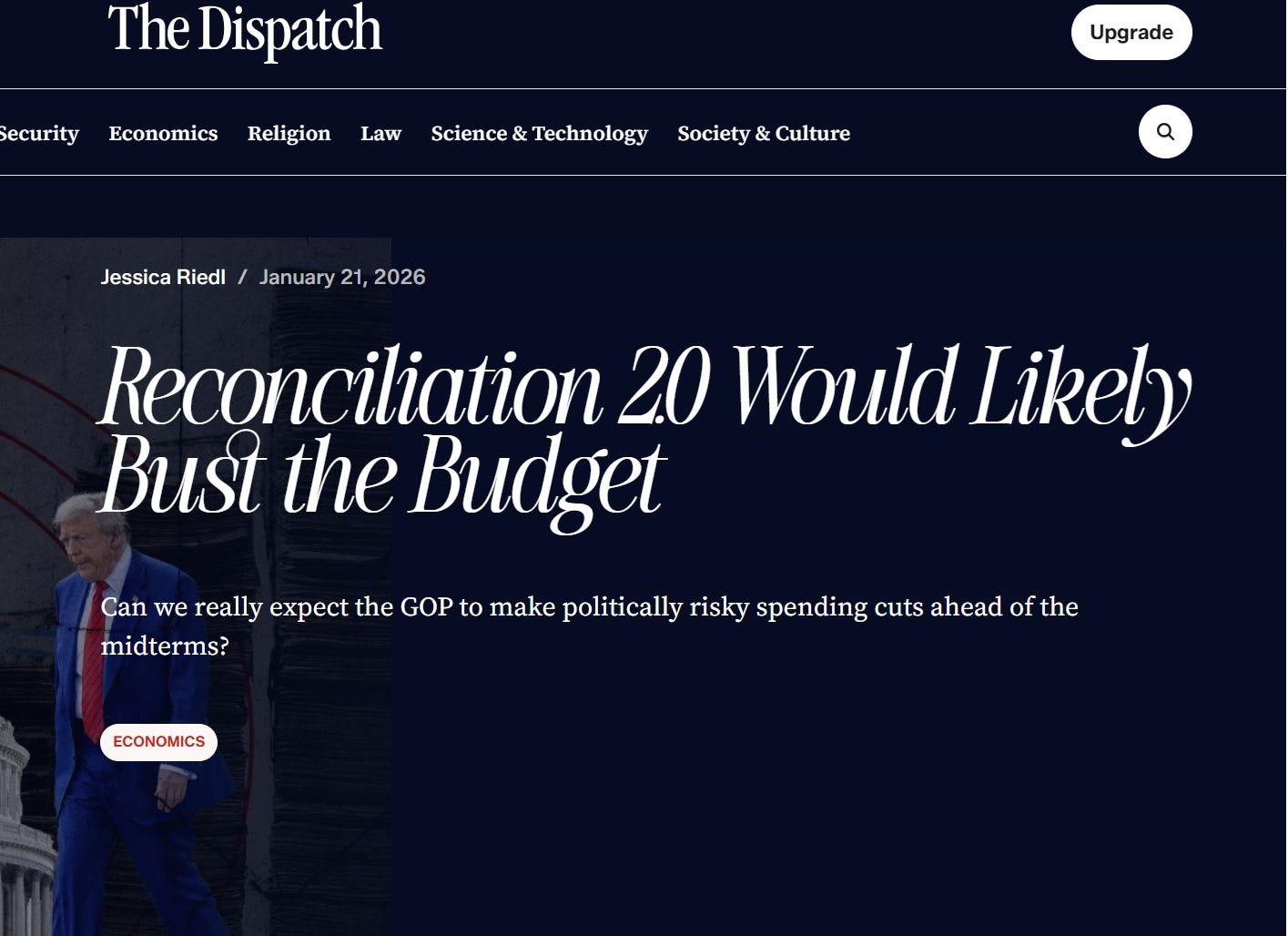
(Originally published in The Dispatch)
Even before the ink dried on the One Big Beautiful Bill Act (OBBBA), many Republican lawmakers were excitedly discussing the possibility of another reconciliation bill. To these conservative lawmakers, Reconciliation 2.0 could include all the deep spending savings that failed to make it into Reconciliation 1.0 (the OBBBA).
Indeed, the House Republican Study Committee (RSC) recently released a Reconciliation 2.0 blueprint that it claims would save $1 trillion over the decade.
Budget savings are desperately needed to combat unsustainable budget deficits heading toward $4 trillion annually within the next decade. Nevertheless, fiscal conservatives and deficit hawks should be strongly skeptical of Reconciliation 2.0. Given the still-shrinking House GOP majority and a critical midterm election approaching, such legislation is overwhelmingly likely to be twisted into another cynical vote-buying indulgence of tax relief and spending expansions. After all, the reconciliation process has produced the overwhelming majority of deficit-expanding legislation over the past quarter-century, and there is no basis for trusting the current Republican government to suddenly use it for courageous (and politically risky) budget cuts before the 2026 election.
Previous reconciliation laws added $16 trillion to the debt.
The temptation of another reconciliation bill is understandable because such bills can pass under an expedited process that a Senate minority cannot filibuster. Broad reconciliation bills are generally limited to one per fiscal year, as long as Congress is willing to first draft and pass a budget resolution (from which the reconciliation instructions spin off). Thus, Congress could perform this exercise once for FY 2026 (which ends on September 30) and then potentially again after the next fiscal year begins on October 1.
Parties with unified control of Congress and the White House seldom let reconciliation opportunities go to waste, as the rule protecting such bills from a Senate filibuster essentially renders the minority party powerless. And while this filibuster-proof privilege was originally intended to facilitate the passage of deficit-reducing legislation, it has since been twisted into a “get out of jail free” card providing the majority party with one annual bill to pack with all the budget-busting tax cuts and spending hikes they could never pass under regular order.
Accordingly, since 2001, the five largest reconciliation laws (plus the 2013 non-reconciliation extension of the reconciliation-passed Bush tax reductions) have cost a staggering $12.8 trillion plus $3 trillion in resulting interest costs for a total of $15.8 trillion in added government debt. This includes two President Bush tax cut bills (2001 and 2003) and one permanent extension of that tax relief (2013), two President Trump tax reductions (2017 and 2025), and President Biden’s American Rescue Plan (2021). Far from facilitating the passage of deficit-reduction bills, the reconciliation process has become a colossal deficit driver.