

(Originally appeared as Brookings Insitution blog post)
Editor’s note: Spending, Taxes, and Deficits: A Book of Charts contains 132 pages of conventional-wisdom-defying insight into federal spending, taxes, budget deficits, and debt in 2026. This is the fourth in a series highlighting key myth-busting charts.
A closer look at basic government data from the Congressional Budget Office, Office of Management and Budget, and the Treasury Department helps answer a basic question: Who—or what—really balanced the budgets from 1998 through 2001?
For many economists, budget experts, and Americans of a certain age, the late-1990s balanced budgets tell a rare government success story. But politicians can’t claim full credit.
Budget deals were all the rage among 1990s politicians
After the federal deficit reached a post-World War II peak of 6% of gross domestic product (GDP) in 1983, deficit reduction became a leading issue in American politics. Several deficit-reduction laws were passed in the late 1980s and early 1990s. Billionaire and 1992 presidential candidate Ross Perot earned a surprising 19% of the popular vote thanks to a quirky campaign that focused heavily on fiscal responsibility.
The winner of that 1992 race, Bill Clinton, subsequently made deficit reduction a centerpiece of his first budget submission and tax increase enactment. The following year, Rep. Newt Gingrich (R-GA) led Republicans to their first House majority in 40 years on a promise to balance the budget within seven years.
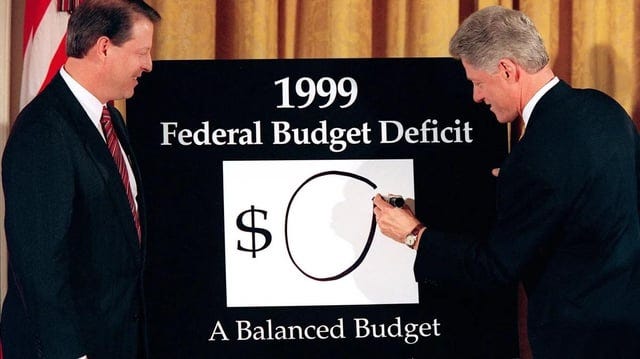
The resulting clash between the GOP’s aggressive timetable and President Clinton’s more gradual approach produced contentious government shutdowns in 1995 and 1996. And yet by 1998 the budget had achieved balance for the first time since 1969—and remained balanced through 2001. A dominant political narrative emerged: High-profile belt-tightening budget deals negotiated by Clinton and Gingrich reduced the deficit and balanced the budget just a few years later.
But budget deals contributed relatively little to balanced budgets
The surprising reality: The elimination of the deficit was largely a temporary historical accident, driven by forces mostly beyond the control of the politicians who claimed credit for it.
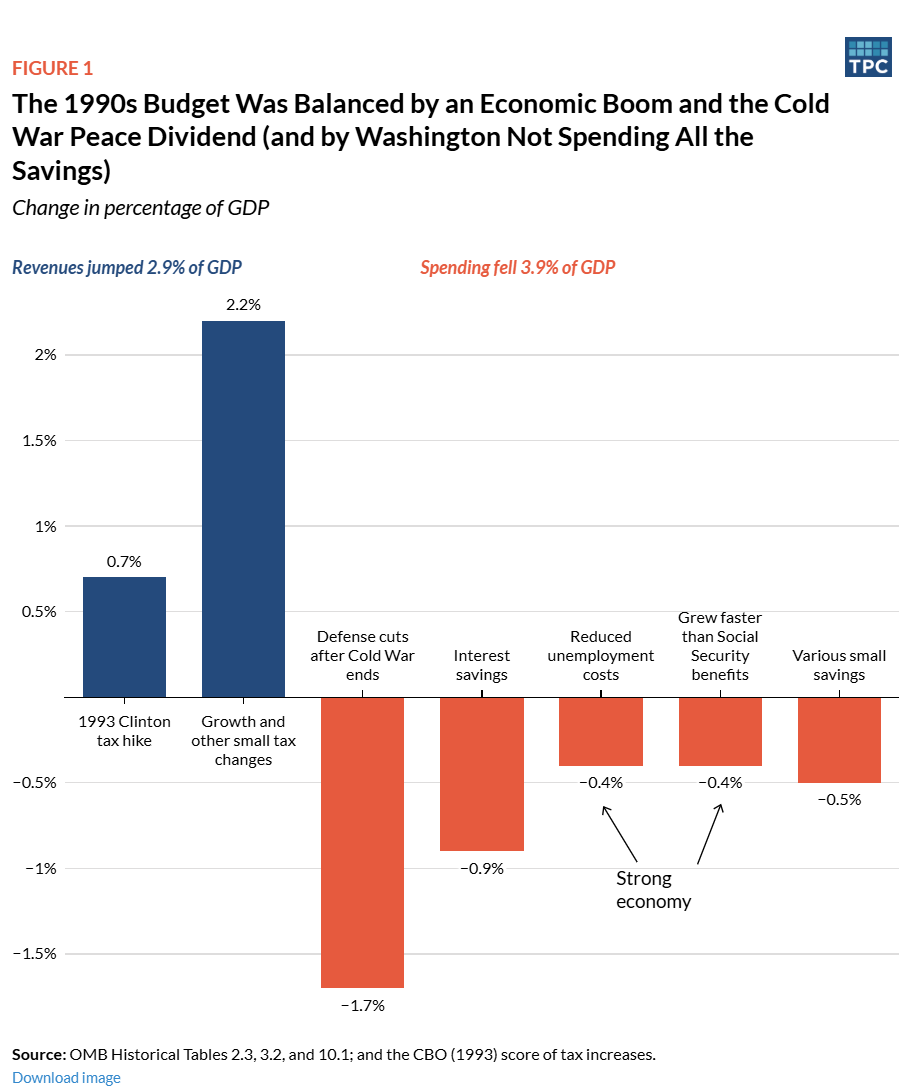
Chart 110 (Figure 1 below) maps the path from 1992’s deficit of 4.5% of GDP to the peak surplus of 2.3% of GDP in 2000—a swing of 6.8 percentage points. Nearly the entire improvement in the federal government’s fiscal position resulted from two events: the end of the Cold War and a temporary stock market and tax revenue bubble.
The end of the Cold War brought defense savings
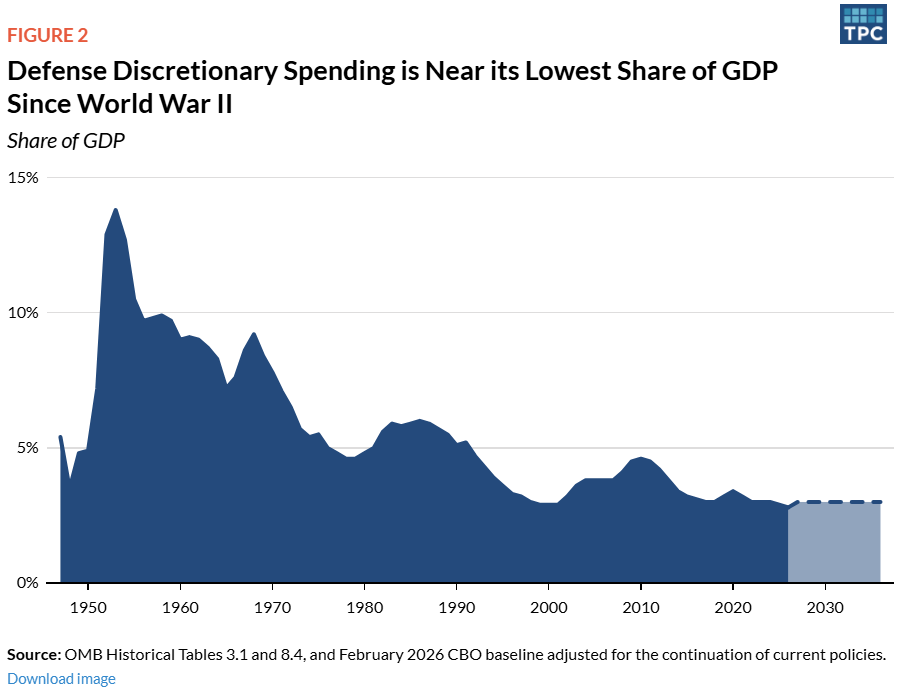
The first major deficit reduction driver was defense savings resulting from the collapse of the Soviet Union. After President Reagan’s Cold War military buildup peaked with a defense budget of 6.0% of GDP in 1986, the collapse of communism in Europe prompted Congress to trim defense spending to 4.7% of GDP by 1992 (see Chart 33, Figure 2 below). Then, during the 1992-2000 period of broader deficit reduction, the defense budget further declined to 2.9% of GDP, the lowest share of the economy since the 1930s. These savings account directly for roughly one quarter of all deficit reduction between 1992 and 2000, and more when the resulting interest savings are incorporated.
Obviously, President Clinton and Congressional Republicans cannot be credited with ending communism in the Soviet Union and Eastern Europe. Such events were driven by decades of internal Soviet and Eastern European developments—perhaps with a nudge from President Reagan and others who had drawn the Soviets into a costly arms race just as their economy was becoming increasingly fragile.
A stock market and tax revenue boom brought even more savings
The second deficit reducer was an unanticipated (and ultimately unsustainable) surge in temporary tax revenues in the late 1990s. Early 1990s corporate restructuring and substantial investments in emerging internet technologies produced a late-1990s burst of stock market and economic activity. That boom produced an extra 2.2% of GDP in annual tax revenues—particularly from capital gains—while simultaneously driving down unemployment costs and other countercyclical spending as a share of the faster-growing economy. Altogether, economic factors account for roughly 60% of all deficit reduction from 1992 to 2000.
It is difficult to identify contemporary White House or congressional policies that produced the corporate restructuring or internet-era expansion. And while Democrats often credit President Clinton’s 1993 tax increases with a significant share of late-1990s deficit reduction, the resulting 0.7% of GDP in tax revenues represents roughly one-tenth of the total improvement over this period. So while Republicans can note that Clinton’s 1993 tax increases were not the primary driver of deficit reduction, Democrats can respond that those increases did not derail the subsequent economic boom as Republicans had aggressively warned.
The accidental nature of 1998–2001 surpluses is confirmed by their quick unraveling
Shortly after the 1990s ended, the same two factors that had accidentally balanced the budget—an absence of powerful global adversaries and an aggressive tax revenue bubble—reversed course and unbalanced it. In 2000, the stock market bubble burst because any of the technology companies commanding enormous valuations couldn’t generate profits to justify them. The Nasdaq began a freefall that ultimately reached 77%. In early 2001 the economy fell into recession, erasing the earlier tax revenue surge. Then the September 11, 2001, attacks prompted a reversal of earlier defense reductions.
The federal budget has run deficits ever since, and they have expanded substantially—the product of repeated tax cuts, spending increases, and the long-anticipated costs of 74 million retiring baby boomers receiving Social Security and Medicare.
Politicians can claim credit for one kind of success
The balanced budgets of the late 1990s—and the swift return to deficits that followed—are a useful reminder of how elected officials often have less control over short-term federal budget fluctuations than is commonly believed.
Politicians routinely receive too much credit when things go well, and too much blame when things go wrong. In this case, there is little basis for crediting 1990s politicians with the broader geopolitical, economic, and technological forces that eliminated budget deficits between 1998 and 2001.
Perhaps the politicians’ true fiscal achievement of the 1990s was more modest. They stayed out of the way on economic and foreign policy and then resisted the temptation to spend the resulting windfall on expensive new initiatives—at least temporarily.
For more insights into federal spending, taxes, deficits, and debt, check out Jessica Riedl’s 2026 federal budget chartbook.
CLICK HERE for article posted at the Brookings Institution site
Hi Jessica. A very interesting piece.
I lived through this time. Indeed I remember the first oil crisis of the early seventies. And the subsequent gold hike.
You are correct. The stars aligned for Clinton. Reagan and his resultant arms reduction helped the later administration by removing the need to spend on arms as before. At the same time increased tax take both meant a surplus. That should tell a tale. But alas it doesn’t . As reduced spending and increased tax is just a two dimensional accounting success. Not an economic success. It was a happy result of fortune. Not a driven success by political control.
If I may help you, any economy has to be governed. Controlled and be system led. We have seen none of this. Not from successive US administrations or from my government here in the UK. Indeed the absence of understanding and guidance has been massively detrimental to our combined success.
For an economy to work you have to stop thinking in two dimensional bookkeeping and think in four dimensions.
Money has to come in, go out but crucially go back around again and again and in a time that makes everything and everyone work. Literally work.
The basics are easy. Money is a token of work effort or production. It is used to exchange out work for yours and everyone else’s. And money being used as an exchange of that effort is the issue! We have allowed our system to be so uncontrolled that money isn’t even exchanged!
We pass money in by SPENDING it, to reward those who may or may hurt deserve it but it has become apparent that their receipt of money isn’t being passed back in a three dimensional way and not us it being given a time scale either!
So the whole of our economy is reliant on two dimensional thinking and accounting. You yourself rely on the idea of balancing the books! As if it were only as easy as that!!
Governments are supposed to be there to govern. But we have seen precious little change in the system we have for hundreds of years. Despite them having skin in the game, they too need money and rely on the SPENDING of others to get their rewards and being referee they still refuse to change anything. But crucially they are the writers and authors of the rules! And still they fail us.
Money is a token. It’s meant to fulfil the SWAP of work effort. And to grasp this idea then you have to accept that it snd our economy relies on money being the exchange of combined effort. Otherwise the notion of fair and full exchange to not just give reward but to receive it again can’t be guaranteed!
So it’s a missing link of our economies that, that understanding is missed. We collectively don’t understand the need to have money flowing constantly to SPEND and receive from and by the SPENDING of others.
Our present system allows money to be UNSPENT. Idle, unused, unredeemed and in so doing STOPS the very flow and recirculating of money itself. Not only that, unspent money isn’t even taxed! But that’s just three dimensional absence. It has no time limit attached. So again the fourth dimensional aspect is list I. Our economy.
If you treat our economy like a household budget or a business accounts session then you or they will never get the system that works.
GDP is gross domestic production! It’s measured by money. Because you can’t quantify production. So it follows that to get production you need money. To get a rise in production you need more money or more specific more money bring SPENT to occur then it was last measured.
In other words to get growth from a level of rock bottom ( no growth) to a desired level of full growth then, you need much more SPENDING to achieve that. But in a four dimensional case the. You need to add I. Time to that equation.
Because production, the growth of production you must first get MONEY. Indeed there is an equation of MS=R. Money multiplied by SPENDING equals Revenue. Revenue is the amount of MONEY from SPENDING.
Our system does not include the third or fourth dimensional aspects. As such the system is flawed. It will never work for all nor will it ever reach optimum state. It’s impossible to get there with the two dimensional thinking you and they use.
No currency lex economy will ever work unless we first have MONEY and SPENDING. And our system may be insufficient in both. This is the factor in its inability to work.
For instance, there had to be sufficient money in the economy for its population and its need. This calculation isn’t being done. But it needs to be thought about. Is there sufficient money in our economy and is it being SPENT?
Well I can tell you that from the unbalanced books we must certainly have insufficient money and SPENDING. Because if we had sufficient then we would be running surpluses!
We run deficits because we have insufficient money and spending. It’s that simple.
Our attitude to money is the problem. We should think about money as a token of full and fair exchange. Not as an asset to be held or rather withheld. It’s your be fully exchanged in the same time frame as received as it must fulfil its intended duty to supply the economy constantly and perpetually. It is meant to be used over and over again by everyone included government.
It is big to be received and never returned! It’s not meant to be kept. If that were so then we should just keep printing it! But we don’t. Because it had to be valued it had to be exchanged to establish that value otherwise it becomes worthless. It’s had to be SPENT.
And there lies the problem. Banks and those holding money are allowed not to spend. Not to resupply and that’s the issue. That’s the flaw.
Banks in my view must facilitate flow not halt it or delay it. They withhold money from its intended path.
Money is collectively required.
Now I’m no communist. I’m all for rewarding extra to those who are brilliant or skilled or just popular! Good luck I say. But unless they SPEND it back then the system flow stops. It strangles the pathway we all need to resupply and reward.
That’s why we have recessions stagnation and depressions. Not for the lack of money, maybe, but more the lack of SPENDING.
We have been used to this outdated system not supplying us. Allowing vast sums to be kept unspent! No wonder we are short of it. The few dictate to the majority. That’s not just unfair it’s undemocratic.
Thanks for setting the record straight.