

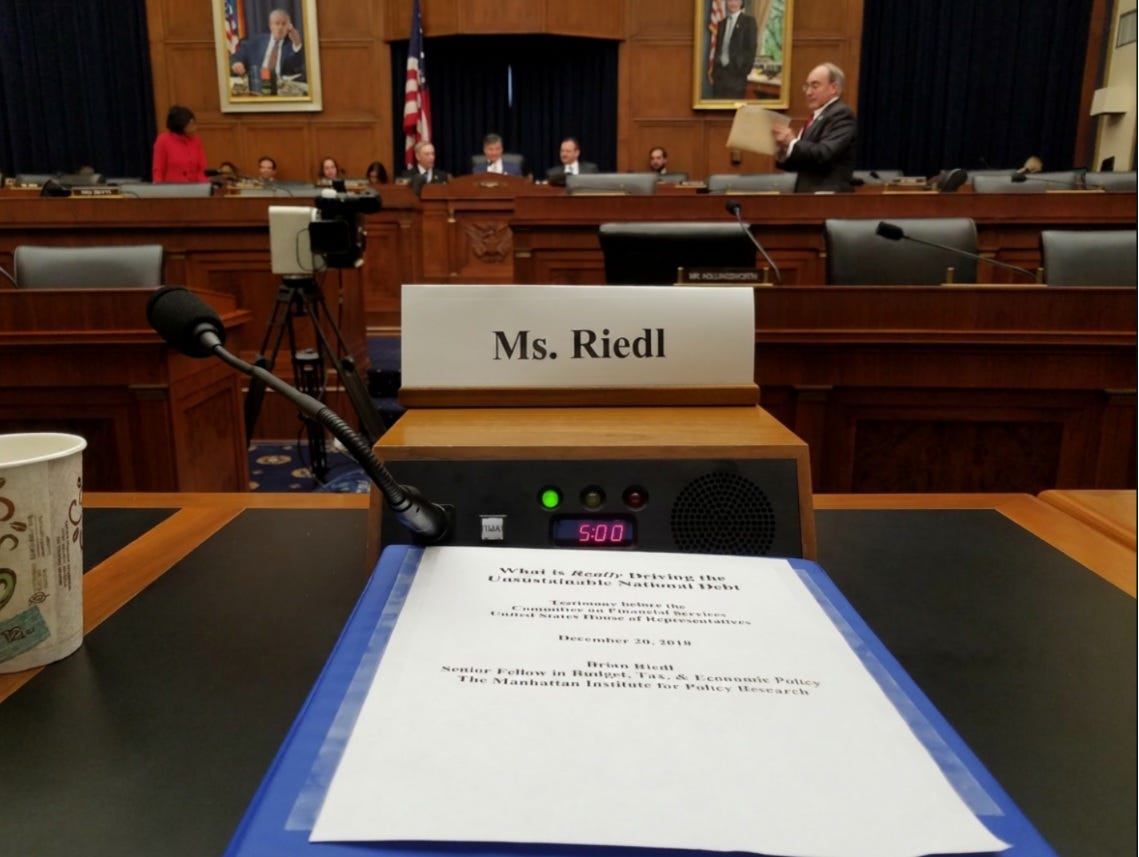
Congress Must Address Washington’s Unsustainable Debt Path
Jessica Riedl
Senior Fellow in Budget, Tax, & Economic Policy
The Manhattan Institute for Policy Research
Testimony before the Committee on the Budget
United States Senate
May 4, 2023
Good morning, Chairman Whitehouse, Ranking Member Grassley, and Members of the Committee. Thank you for inviting me to participate in today’s hearing in a committee where I have many fond memories of staffing so many hearings back when I was the chief economist to Senator Rob Portman.
Today, I will make three main points.
First, that the current debt path is unsustainable and requires immediate attention.
Second, that there is a long, bipartisan history of attaching deficit reforms to debt limit bills.
Third, that ultimately the debt limit must be raised on time, no matter what.
On the first point, the federal debt is totally unsustainable. The deficit will likely settle in around $1.5 trillion this year and approach $3 trillion within a decade even assuming peace, prosperity, and low interest rates. That comes to $20 trillion in new borrowing over the decade, even if the 2017 tax cuts expire.
The long-term projections are worse. CBO forecasts a staggering $114 trillion in baseline deficits over the next 30 years – pushing the debt to nearly 200 percent of GDP. Virtually the entire projected shortfall is from Social Security and Medicare systems that CBO forecasts will run $116 trillion in shortfalls. These two programs – by themselves – will run a 13 percent of GDP deficit by 2052.[i]
Even under those baseline assumptions of low interest rates, interest costs will set a record share of GDP within a decade, and consume half of all tax revenues in 30 years. If interest rates rise – as we are seeing – each percentage point will cost $3 trillion over the decade and $30 trillion in added interest costs over 30 years. By that point, interest costs could easily consume 70 or even 100 percent of tax revenues.[ii] With respect to interest rates and soaring debt, we are sitting on a ticking time bomb.
Congress should be working diligently to avert an otherwise-inevitable debt crisis. And raising the debt limit has historically been one opportunity to address the underlying debt problem.
For decades, the debt limit served as a legitimate tool for both Republicans and Democrats to address budget deficits. Debt-limit “showdowns” were relatively rare because both sides recognized the need to include fiscal reforms. Indeed, of the eight largest deficit-reduction laws since 1985, all eight were attached to debt-limit bills.
This includes both Gramm-Rudman laws in the 1980s, the 1990 Bush tax hikes, the 1993 Clinton tax hikes, the 1997 Balanced Budget Act, the 1996 Line-item-veto law, the 2010 PAYGO law, and the 2011 Budget Control Act. Every one of these deficit reforms was married to a debt limit hike.[iii]
Most of these laws occurred in the 1980s and 1990s – when a 6 percent of GDP deficit was eliminated and turned into a budget surplus. Clearly, both parties have gotten away from using the debt limit to address red ink – just as both parties bear responsibility for the past decade’s deficits. But the unsustainable debt means that all legislative avenues should again be open.
This is perhaps why a new survey shows that 74 percent of voters – including 58 percent of Democrats – agree with the statement that “President Biden should agree to negotiations and try to find common ground around the debt ceiling, including some reductions in government spending.” Just 26 percent believe the president should resist negotiating and demand a clean debt ceiling hike.[iv]
All that said, I agree that the debt limit must be raised on time, no matter what. Hitting the debt limit would force an immediate 20 percent cut in federal spending, and possibly default on the national debt. The effect on families, businesses, financial markets, and the broader economy would be devastating. That is not a solution to soaring debt. The debt limit must be raised.
In fact, replacing the debt limit should be an option, but only if Congress can come up with an alternative process that would allow members to vote on the entire budget with the true ability to trade-off between competing tax-and-spending priorities. Right now, the debt limit – as flawed as it is – is the only lawmaker vote available that truly covers the whole federal budget. If we don’t want lawmakers to use a risky process to address soaring deficits, then we need to find a better tool to have these debates and votes.
Thank you.