


Executive Summary
Annual budget deficits doubled to $2 trillion over 2022–23 and are headed toward $3 trillion a decade from now. Social Security and Medicare face a combined $124 trillion cash deficit over the next 30 years. The national debt is projected to soar past 165% of gross domestic product (GDP) within three decades—or as high as 300% of GDP if interest rates remain elevated and Congress extends expiring policies. At that point, interest costs could consume half to three-quarters of all federal tax revenues. Unless reforms are enacted, Washington’s escalating borrowing demands will come to overwhelm the capacity of financial markets to supply this much lending at plausible interest rates. When that event occurs, or even approaches, interest rates will soar and the federal government will not be able to pay its bills, with dire consequences for the U.S. economy.
In short, Washington is on a totally unsustainable fiscal path, and a debt crisis is coming.
There is a way to avert this debt crisis. However, lawmakers must act quickly to reform Social Security and Medicare, as every year 4 million more baby boomers retire into those programs, and the eventual cost of reform rises by trillions of dollars. This report presents a realistic, nonpartisan, and specific 30-year blueprint—each element of which is “scored” using data from the Congressional Budget Office (CBO)—to stabilize the national debt at the current 100% of GDP, and even reduce it eventually.
The fiscal consolidation in this report calls for trimming some Social Security and Medicare benefits for upper-income recipients. Some taxes would rise. Spending on defense would continue to fall as a share of the economy. In short, there is something in this blueprint for everyone to oppose. But letting the country plunge into a debt crisis would be far more painful than this blueprint’s reforms.
Introduction
Annual budget deficits doubled to $2 trillion over 2022–23 and are headed toward $3 trillion a decade from now (Figure 1).[1] Social Security and Medicare face a combined $124 trillion cash deficit over the next 30 years. The Congressional Budget Office (CBO) projects that the national debt will soar past 165% of gross domestic product (GDP) within three decades—or as high as 300% of GDP if interest rates remain elevated and Congress extends expiring policies.[2] At that point, interest costs could consume half to three-quarters of all federal tax revenues. Unless reforms are enacted, Washington’s escalating borrowing demands will, at some point, overwhelm the capacity of financial markets to supply this much lending at plausible interest rates. When that event occurs, or even approaches, interest rates will soar and the federal government will not be able to pay its bills, with dire consequences for the U.S. economy.
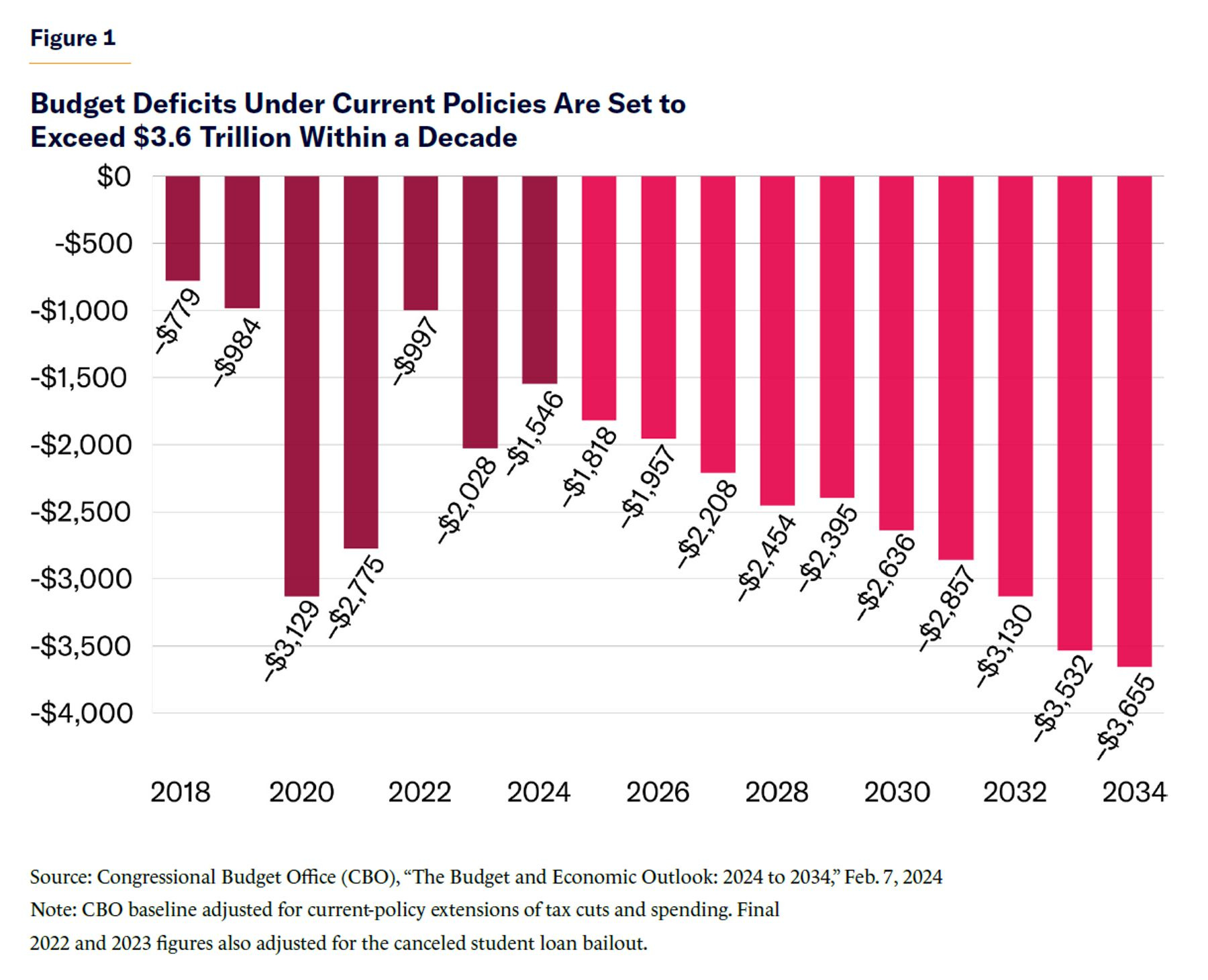
In short, Washington is on a totally unsustainable fiscal path that virtually ensures some version of a debt crisis. Yet most lawmakers tasked with the responsibility of averting that outcome express little interest in doing so. No recent president has presented a specific plan to stabilize the long-term budget, and Presidents Trump and Biden each added trillions in new debt. Congress continues to drive up federal spending, and is soon likely to renew trillions of dollars in expiring tax cuts. President Biden and Republican lawmakers compete to see who can most vociferously oppose any reforms to Social Security and Medicare’s massive shortfalls, as well as any new taxes for all but the top-earning 5% of earners. Deficits rise by $1 trillion annually while proposals to trim even a few billion dollars are met with overwhelming resistance. Surveys show that voters continue to demand even more tax cuts and spending hikes.[3]
Thus, American presidents, lawmakers, and even voters are in deep denial of the fiscal reckoning that is ahead. Interest rates are already rising, and politicians have made popular long-term spending commitments that vastly exceed what they are willing to tax and what the financial markets will be able to lend. The only decision is whether Washington gradually imposes savings proposals on its own terms, or whether it waits for a debt crisis to impose much more drastic and painful savings reforms.
There is a way to avert this debt crisis without historic broad-based tax increases or significant cuts to antipoverty and social spending. However, lawmakers must act quickly to reform Social Security and Medicare, as every year 4 million more baby boomers retire into those programs and the eventual cost of reform rises by trillions of dollars.
This report presents a specific 30-year blueprint—each element of which is “scored” against the most recent CBO Long-Term Budget Outlook—to stabilize the national debt at the current 100% of GDP. Section I identifies the drivers of long-term debt. Section II addresses false “easy” solutions deployed to avoid real reform. Section III presents the blueprint. Section IV defends the blueprint against both conservative and liberal objections.
The approach of this report requires a careful explanation. Yes, the current political environment renders virtually every significant deficit reduction proposal fatally unpopular and unpassable (otherwise, they would already have been enacted). However, at some point down the road—whether due to a courageous Congress, a voter uprising, or (most likely) fiscal constraints imposed by financial markets and a weak economy—Congress and the White House will likely be forced to confront deficits and placed previously rejected savings options back onto the table. When Congress finally commits to stabilizing the debt, this report will provide a specific, scored, and potentially bipartisan proposal to achieve that goal.
In other words, this report does not propose yet another hyper-partisan conservative or liberal fantasy scenario. It does not necessarily even feature reforms that the author would select if political compromise were unnecessary. Nor is it just a set of generic (and unrealistic) long-term spending and tax targets without detailing specific programmatic reforms that could meet those targets. This report is intended to provide a specific, well-crafted blueprint that could realistically appeal to both parties if they ever commit themselves to stabilizing the debt.
The fiscal consolidation in this report calls for some Social Security and Medicare benefits for upper-income recipients to be trimmed. Some taxes would rise. Spending on defense would continue to fall as a share of the economy. In short, there is something in this blueprint for everyone to oppose. But letting the country plunge into a debt crisis would be far more painful than this blueprint’s reforms.
I. Why the Debt Is Soaring
From the mid-1950s through 2008, the national debt held by the public averaged 35% of GDP (typically ranging between 25% and 50%). This level of borrowing could easily be absorbed by the increasingly global financial markets, and it resulted in interest costs averaging 2% of GDP (roughly 10% of a typical federal budget). Since 2008, the great recession and the beginning of the baby-boomer retirements have nearly tripled the debt, to 100% of GDP.[4] If current policies continue, the debt is projected to reach an unprecedented 236% of GDP within 30 years.[5] Interest would become the largest federal expenditure and consume a majority of federal taxes.
Even these escalating debt estimates accept CBO’s rosy assumption that the interest rate paid on the federal debt gradually rises to 3.8% over three decades. Yet the 10-year Treasury bond (which often approximates the average rate paid on the federal debt) has already spent the first half of 2024 at 4%–5%. While the Federal Reserve is expected to reduce interest rates within the next year, both history and economic fundamentals suggest that the rate will not return to the abnormally low federal funds rates that prevailed between 2008 and 2021. Over time, interest rates are more likely to rise because of a less-accommodating Federal Reserve, retiring baby boomers moving from savers to spenders, a lessening of the global savings glut, and the economic consensus that a steeply growing federal debt will push up interest rates.[6]
Each percentage point that interest rates exceed the 3.8% baseline estimate would saddle Washington with an additional $35–$45 trillion in interest costs over three decades—nearly the cost of adding another defense department (again, that is for each percentage point). If the average rate on the federal debt rises to 5% or 6%, the federal debt could exceed 300% of GDP within three decades (Figure 2). At that point, interest on the debt would likely consume nearly all federal taxes. Higher interest rates would also affect borrowing for housing, cars, student loans, and business loans, risking a significant economic slowdown. Unlike Greece’s, the U.S. debt would be too large to be easily absorbed by the global economy.
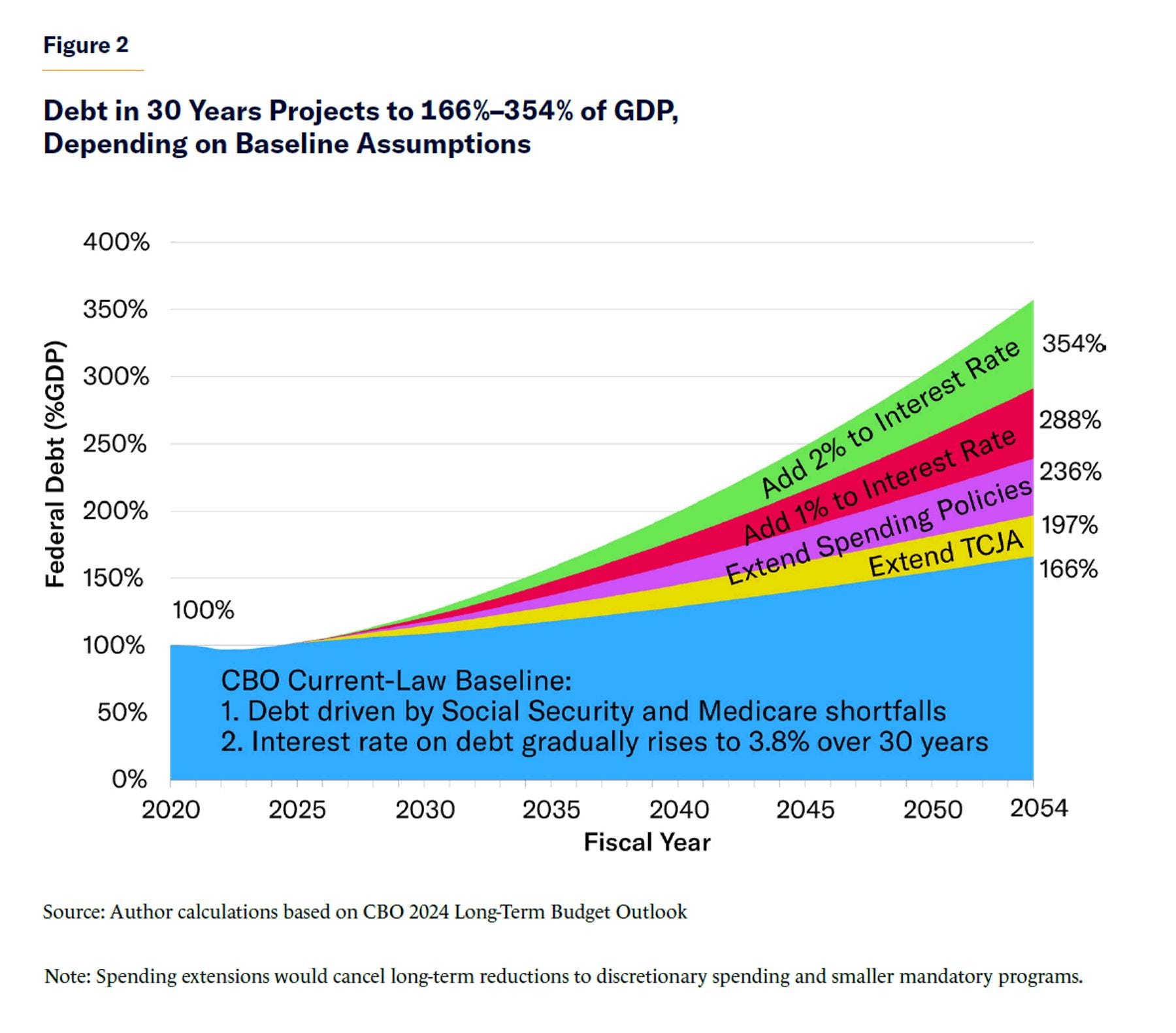
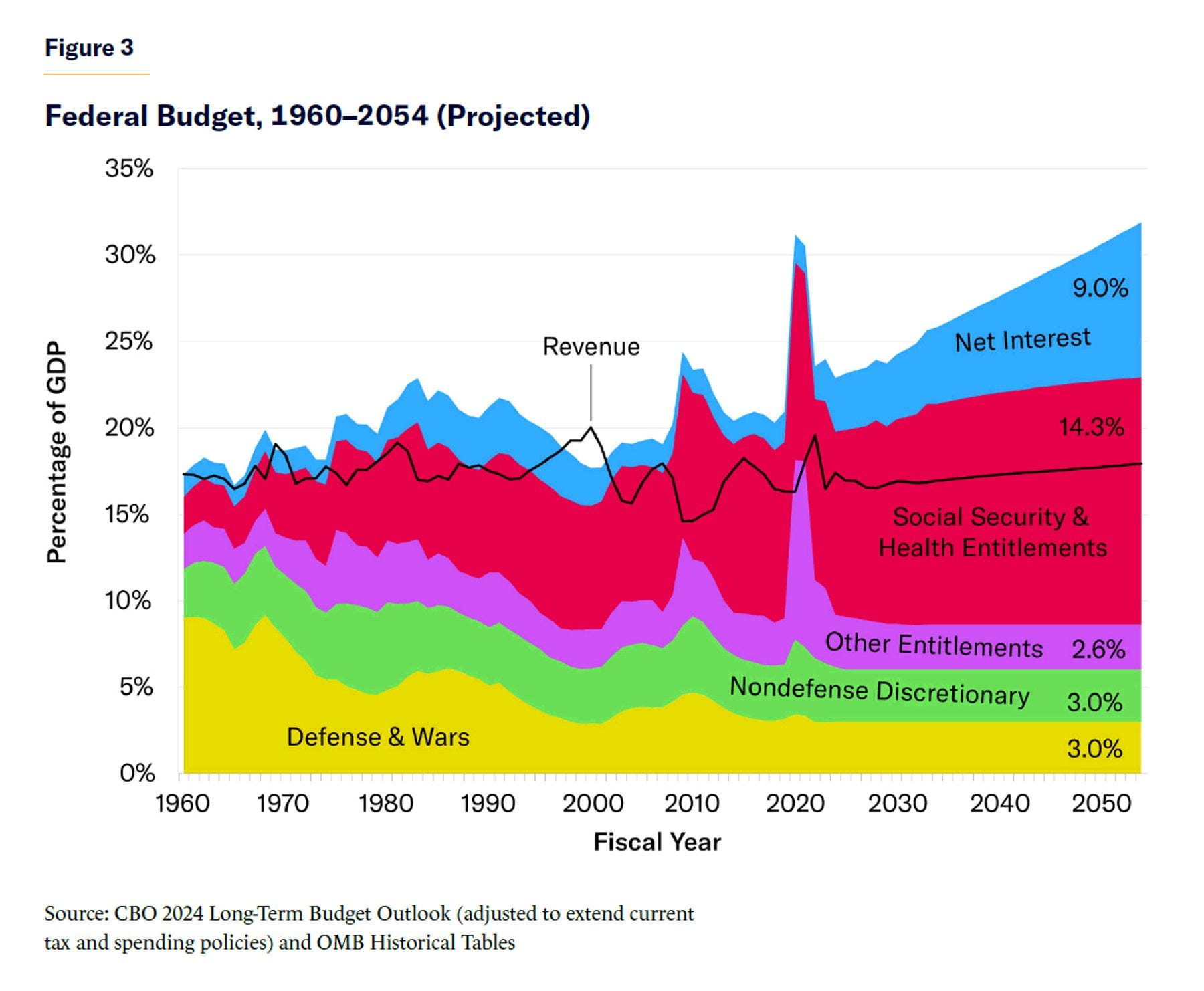
This is not a problem caused by falling tax revenues. Even as tax rates greatly fluctuated, federal revenues have averaged 17.4% of GDP since 1960, and are projected by CBO over the next three decades to grow to 18.8% of GDP (or 17.9% if the 2017 tax cuts are renewed). On the spending side, both discretionary spending and outlays for smaller mandatory programs are projected to fall as a share of the economy over time.
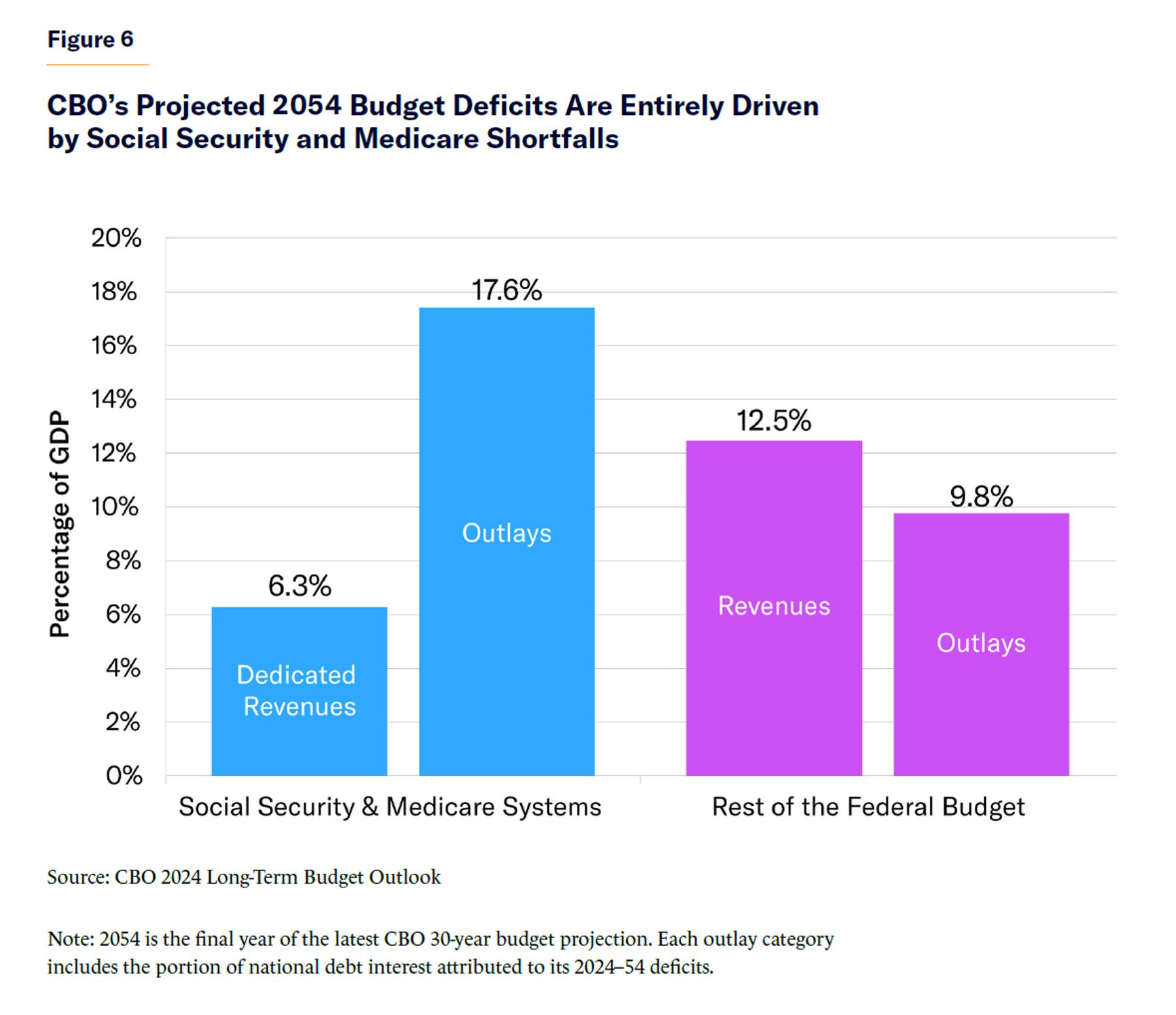
Instead, the entire increase in long-term debt will come from surging Social Security, Medicare, and other government health-care spending (Figure 3). According to CBO, these costs have risen from 7% to10% of GDP since 2000 and are projected to reach 14.3% of GDP by 2054—or 20.6% of GDP when the interest cost of Social Security and Medicare’s annual deficits are included. By 2054, CBO data project the Social Security and Medicare systems to run an annual combined deficit of 11.3% of GDP—and the rest of the budget to run a 2.8% of GDP surplus.[7]
Why Social Security and Medicare Face a $124 Trillion Cash Shortfall
It is a popular myth that Social Security and Medicare are fully paid for and cannot contribute to budget deficits. In reality, Medicare Parts B and D benefits (physician and drug benefits, respectively) are not pre-funded by payroll taxes at all and represent a federal handout no different from any other income support program (senior premiums finance only one-quarter of their cost). The “trust-fund” programs of Social Security and Medicare Part A are entitled to run annual deficits in proportion to their prior-year program surpluses, while receiving annual general revenue subsidies in the form of interest payments on their bonds (and occasional bailouts of payroll-tax holidays). Moreover, CBO projections assume that Social Security and Medicare Part A benefits will continue to be deficit-financed even after their trust-fund balances reach zero in the next decade.
The costs are soaring, as well. Between 2008 and 2030, 74 million Americans born between 1946 and 1964—on average, 10,000 per day—will retire and receive Social Security and Medicare benefits. Of this group, those collecting early retirement at age 62 and living to age 84 will spend one-third of their adult life receiving federal retirement benefits.[8] The combination of more retiring baby boomers and longer life spans will expand Social Security and Medicare caseloads far beyond what current taxpayers can afford under current benefit formulas. In 1960, five workers paid the taxes to support each retiree (and, of course, Medicare did not exist). The ratio of workers to retirees has now fallen below 3–1, and is on its way to 2–1 by the 2030s. When today’s teenagers are adults, each married couple will basically be responsible for the Social Security and health care of their very own retiree.
These demographic challenges are worsened by rising health-care costs and repeated benefit expansions enacted by lawmakers. Today’s typical retiring couple has paid $214,000 into Medicare and will receive $635,000 in benefits (in net present value), partly because Medicare’s physician and drug benefits are not pre-funded with payroll taxes and are only partially funded by retiree premiums.[9] Most Social Security recipients also come out ahead. Thus, most seniors’ benefits greatly exceed their lifetime contributions to the Social Security and Medicare systems. By 2030, 74 million baby boomers will have joined a retirement benefit system that runs a substantial per-person deficit.
This year, Social Security and Medicare will collect $1,701 billion in payroll taxes and dedicated revenues and pay $2,349 billion in benefits. Add in $21 billion in resulting interest costs from this borrowing, and Social Security and Medicare will contribute $651 billion to the 2024 budget deficit. As Social Security and Medicare costs mount, these annual shortfalls will leap to $2.2 trillion a decade from now (Figure 4).[10] This will drive the vast majority of the growth of the budget deficit.
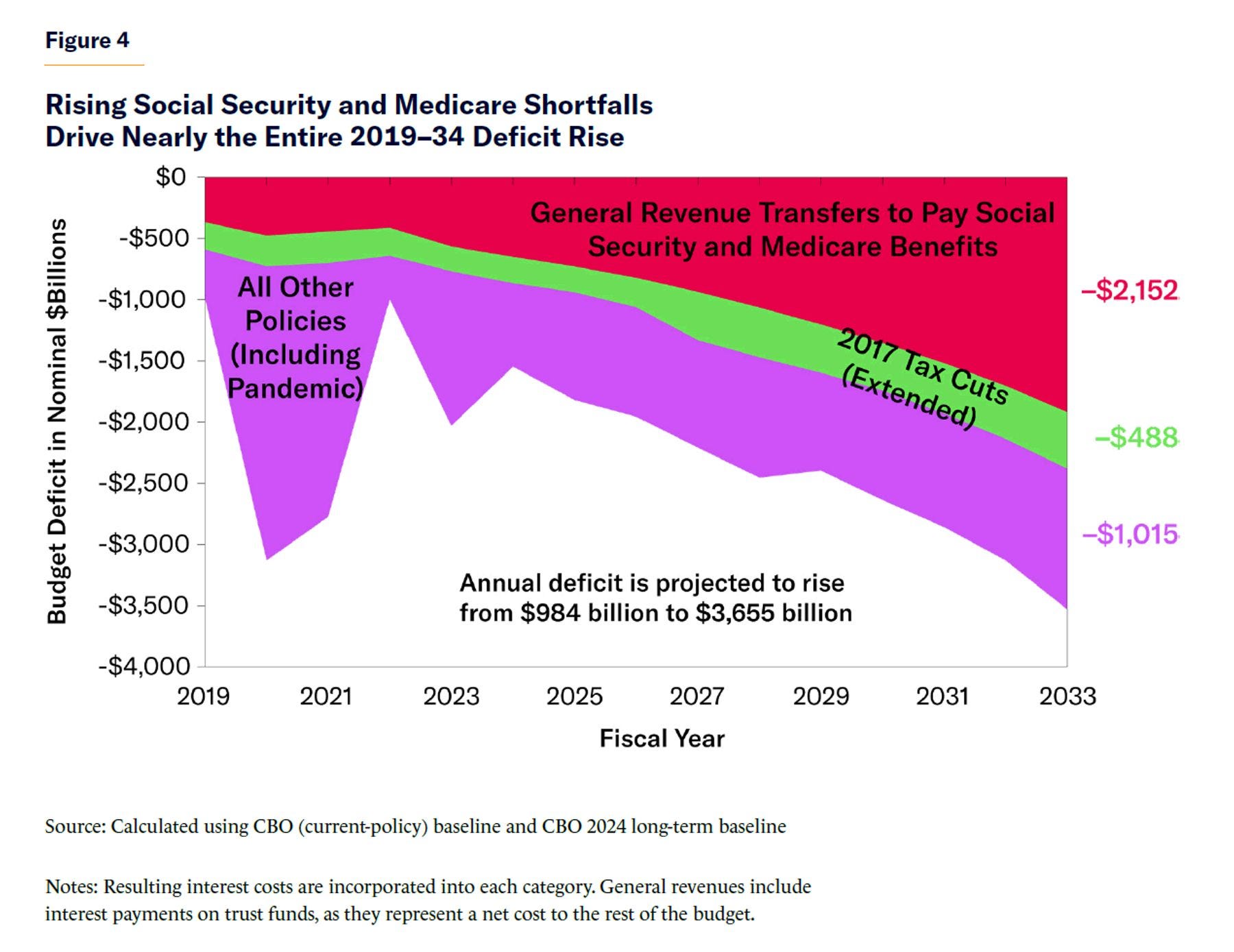
The long-term figures are even more dire. CBO data project that, between 2024 and 2054, Medicare is projected to collect $28 trillion in dedicated revenues (such as payroll taxes) and spend $77 trillion in benefits. This shortfall will, in turn, add $38 trillion in interest costs, bringing Medicare’s total budgetary shortfall to $87 trillion. During that same period, Social Security will collect $74 trillion and spend $94 trillion, combining with $17 trillion in resulting interest costs for a total shortfall of $37 trillion (Figure 5).[11] (To adjust these 30-year totals for inflation, trim by one-third.) Rather than adequately self-finance through payroll taxes and premiums, these two programs are set to add $124 trillion to the national debt over three decades. The rest of the federal budget is roughly balanced over the next 30 years, depending on the fate of the 2017 tax cuts and discretionary spending.
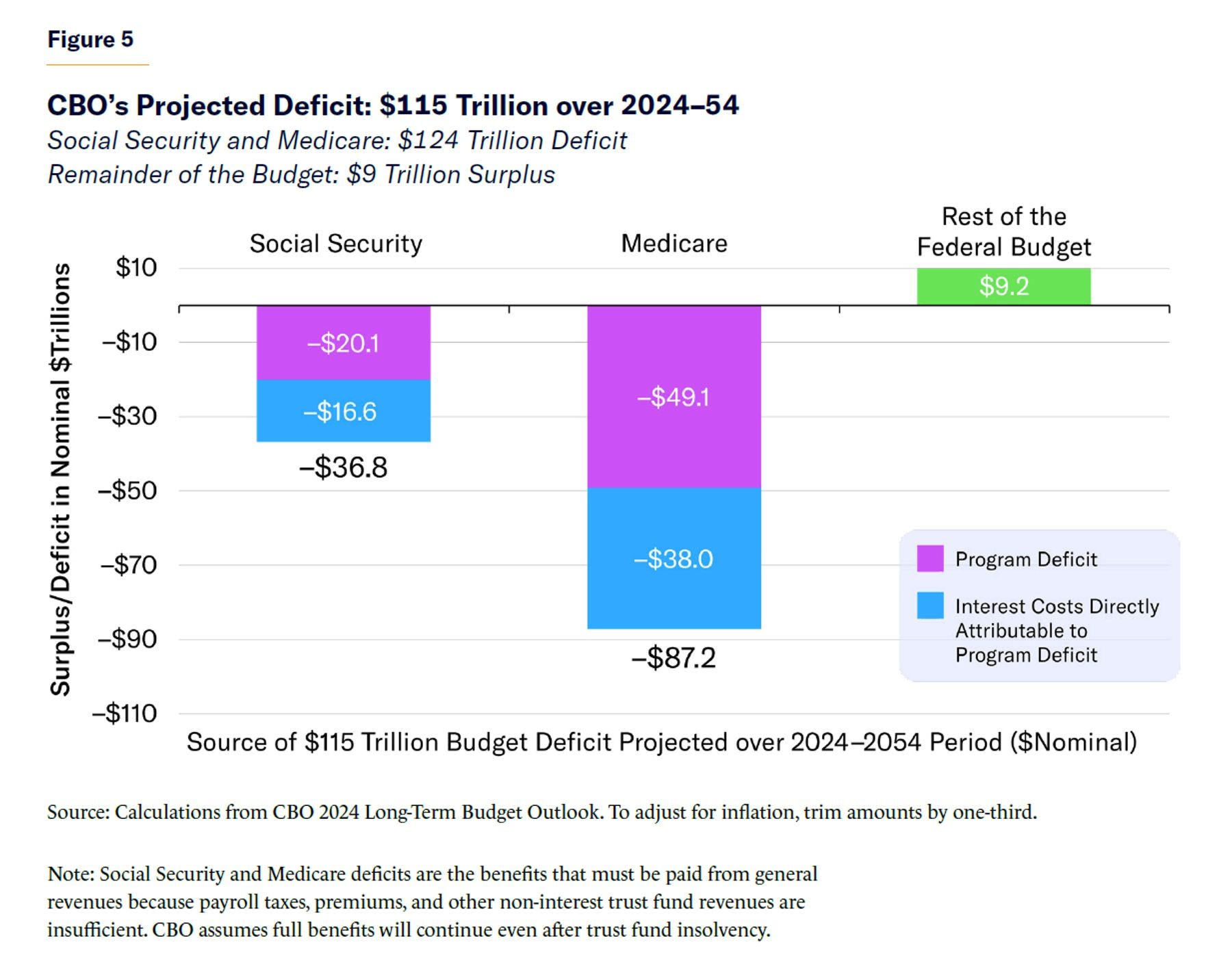
Figure 6 expresses the same projections in a different manner. By 2054 Social Security and Medicare will collect 6.3% of GDP in dedicated revenues and spend 11.3% of GDP in benefits—plus 6.3% of GDP in interest costs resulting from these two programs’ deficits. Allowing two programs to run a budget deficit of 11.3% of GDP is unsustainable. There is no way for other tax increases or spending cuts to finance that gap.
Most Seniors Are Not Poor
The Social Security and Medicare debate often brings opposition to reform based on the myths that: 1) most seniors are poor; and 2) seniors are simply getting back the money they paid into Social Security and Medicare. The first myth of widespread senior poverty is a holdover from the 1930s, when Social Security was created. Today, senior citizens are the wealthiest age group of Americans in history.[12] Millions of retiree households continue to earn incomes greater than $100,000 even after retirement, driven by (nonhousing) net worths in the millions.[13] Senior household incomes have grown 60% faster than inflation since 1980, compared with 15% for the average worker.[14] In fact, because most retirees are wealthier than the taxpayers financing their benefits, Social Security today largely redistributes income upward, not downward. These effects are further magnified by the fact that most seniors no longer face mortgage or child-raising expenses. Of course, many seniors still struggle (which can be affordably addressed by hiking the minimum benefit). Nevertheless, seniors have the lowest poverty rate of any age group.[15]
The relative wealth of seniors should influence the conversation of the second myth that seniors are merely getting back what they paid in. A middle-earning couple turning 65 years old next year will have paid $997,000 over their lifetime into Social Security and Medicare yet receive $1,466,000 in benefits (all adjusted into present value). Lower-earners as well as one-earner couples will come out even further ahead. Moreover, Social Security and Medicare automatically become more generous for each generation (even after adjusting for inflation), partly because of benefit formulas that provide subsequent generations with much higher initial benefits. A middle-earning married couple retiring in 2050 will receive Social Security benefits that are more than double the benefits of those who retire in 2000 (again, these figures are adjusted for present value).[16]
So a key question for policymakers is whether it makes sense to raise taxes on working families by a staggering $69 trillion over three decades[17]—in the largest intergenerational wealth transfer in world history—to ensure that even millionaire seniors can continue to receive Social Security and Medicare benefits far exceeding their lifetime contributions to those systems (this figure reflects the program shortfalls excluding interest costs that would be averted).
Time Is Running Out for Reform
A common argument against addressing Social Security and Medicare is that “we’ve been hearing these same fake warnings for decades and nothing has happened.” This view misinterprets the warnings. Between 1999 and 2023, the year in which the Social Security trust fund was projected by the system’s trustees to reach insolvency has moved up—not back—from 2036 to just 2033.[18] This period corresponds to the point at which virtually all 74 million baby boomers will have retired into Social Security and Medicare, and rising health-care costs will have deepened Medicare’s shortfalls. The aggressive case for reform in the 1990s and early 2000s was driven not by an impending budget crisis but rather a hope that Social Security and Medicare reforms could be gradually phased in while the baby boomers were still in their peak earning years. That opportunity was missed, and now the Social Security trust fund is in deficit and heading toward insolvency on a similar schedule as was warned 25 years ago. Medicare’s annual shortfalls (most of which are not limited by a trust fund) are accelerating as well.
Thus, responsible reforms cannot wait any longer. Every year, 4 million more baby boomers retire into Social Security and Medicare, and within six years nearly all 74 million will be retired. As baby boomers move into their seventies and eighties, they will be unable to absorb any significant reforms to these programs—leaving the massive taxpayer costs politically irreversible. Surging interest costs are mostly irreversible, too, because of the rising debt that will have accumulated (and will continue to accumulate if Social Security and Medicare cannot be reformed) and because the rising interest rates in this situation cannot simply be reversed, either (unless the Federal Reserve unwisely commits to monetizing much of the debt). In fact, if interest rates are driven upward by financial markets losing faith in the federal government’s long-term ability to manage its debt, the resulting risk premium might remain baked into interest rates for several years or even decades. Thus, every year of delay dramatically raises the cost of reform.
Nor is it any longer sustainable to grandfather out of reform everyone over the age of 50. That window closed in the 2000s, when the trillions in unfunded costs were still 20 years away. Now, such a policy would grandfather out the 74 million baby boomers whose costs are driving the shortfalls, as well as most of Generation X. It would gradually phase in reforms beginning in the 2040s and thus leave in place nearly the entire $124 trillion Social Security and Medicare shortfall that is projected over the next three decades. Decades of denial and procrastination by lawmakers (and voters) mean that Social Security and Medicare reform is no longer just about future generations. More than 10,000 baby boomers are retiring every day, trillion-dollar deficits are here, the trust funds are approaching insolvency, and reform can no longer wait for future generations.
How a Debt Crisis Might Play Out
The national debt’s share of the economy cannot rise forever. At a certain point, even large global savings markets will be stretched, and investor confidence in the U.S.’s ability to finance its debt will evaporate. Additionally, interest costs will consume an increasing share of tax revenues, creating pressure for unpopular tax increases and spending cuts.
It is unclear from whom Washington will borrow as much as $175 trillion (assuming that current tax cuts and spending programs are renewed) over 30 years to cover its projected deficits. China and Japan each hold roughly $1 trillion in U.S. debt and have neither the capacity nor the interest to cover more than a tiny fraction of impending American borrowing.[19] Other countries limit their Treasury holdings, and the Federal Reserve has been trying to shrink its $5 trillion holdings of Treasury debt.[20] That leaves the U.S. financial markets—insurance companies, investors, pension funds, and state and local governments—to cover perhaps $150 trillion in projected Washington borrowing. The impending debt surge has barely begun, and yet a 2023 Wall Street Journal headline had already declared: “Wall Street Isn’t Sure It Can Handle All of Washington’s Bonds.”[21]
Initially, Washington’s insatiable borrowing demands will push up interest rates (which will, in turn, further widen budget deficits). But at a certain point, the financial markets might be unable to supply Congress’s lending demands at plausible interest rates. Even before that point, investors might simply lose confidence in Washington’s long-term finances, and shift their investments away from Treasury holdings. Ultimately, Washington cannot borrow what investors will not lend and a vicious cycle of rising debt and interest rates increasingly appears to be the most likely outcome.
A debt crisis will not likely come in a single cataclysmic crash that brings chaos and depression. Instead, persistent deficits of 8%–10% of GDP might bring a series of financial “mini-panics” of rising interest rates and economic stagnation that force Washington to rein in budget deficits. The most likely scenario involves Congress initially targeting lower-hanging fruit such as taxing the rich, trimming defense, and cutting programs such as foreign aid. When these savings prove insufficient to close such large and swelling deficits, lawmakers might reform other tax breaks, as well as spending on antipoverty and social programs. Eventually, they will discover that Social Security and Medicare shortfalls approaching 10% of GDP cannot remain completely protected by eviscerating the rest of the budget and taxing the rich at revenue-maximizing rates. With all savings alternatives tapped out, the only remaining option will be to go where the money is: Social Security, Medicare, and middle-class taxes. If most baby boomers are too old to absorb benefit changes, financing the projected budget deficits might require payroll tax increases as high as 10% combined with a value-added tax exceeding 10%. The result will be a massive debt, sluggish economy, high interest rates, and European-sized taxes—without the accompanying social benefits enjoyed by working European families.
No one can predict whether the financial markets will force reforms in 5, 15, or 25 years.[22] However, the math always wins, and no economy can finance structural budget deficits of 8%–10% of GDP (and eventually higher) forever. On the one hand, the U.S. will have some leeway due to its reputation as a safe harbor for investment and status as the world’s reserve currency. On the other hand, absorbing a debt of nearly 200% of the U.S. economy would be much more expensive for the global markets than absorbing, say, 200% of a smaller GDP like that of Greece.
There is another potential danger. Rather than allow rising interest rates on the debt to force even larger tax hikes and spending cuts, Congress or the executive branch could simply require that the Federal Reserve maintain low interest rates and purchase much of the debt to reduce interest costs. A version of this approach—known as fiscal dominance—previously occurred during World War II and contributed to substantial inflation and economic instability when the White House and Treasury refused to free the Federal Reserve until several years after the war.[23] Such a response to future deficit projections would surely bring substantial inflation and economic instability.
Lest these fiscal warnings appear excessively alarmist, the sober-minded economists at the University of Pennsylvania’s Penn-Wharton Budget Model recently attempted to analyze the long-term fiscal outlook of the United States.
Their study explains that leading economic models used by economists and by Congress “effectively crash when trying to project future macroeconomic variables under current fiscal policy. The reason is that current fiscal policy is not sustainable” (italics added).[24] In fact, the Penn-Wharton economists note that the current fiscal trajectory is so dangerously untenable that economic modelers are forced to add in an assumption that Washington aggressively raises taxes and/or slashes spending. They simply cannot model a functioning long-term economy at the baseline-projected debt levels.
II. The Mirage of “Easy” Solutions
Standing in the way of making the changes to be outlined in this budget plan—or other plausible proposals to avert a debt crisis—are a series of false claims that the problem is easily solved.
Economic Panaceas
Steep economic growth. Political candidates routinely promise to address deficits by producing economic growth rates of 4% and even 5%—more than double the projected levels—while citing the fast economic growth in the decades following World War II. The first problem with this promise is that the economic growth of the 1950s–1970s was primarily driven by the large labor-force expansions of women and then baby boomers. However, the size of the labor force is projected to grow by just 0.1% annually over the next 50 years as the baby boomers retire, birth rates slow, and immigration rates dip.[25]
That leaves productivity to drive nearly all economic growth. CBO projects that total factor productivity growth will average 1.1% annually for the next three decades—roughly matching the last three decades, which included a late-1990s technology boom.[26] If productivity somehow grows by 1.6% annually—nearly 50% faster than CBO’s 1.1% long-term annual projection—it would shave approximately 44% of GDP off the projected debt growth within three decades.[27] The debt would still continue growing to unsustainable levels, but each given debt level would occur a decade later than under baseline productivity growth. In other words, economic growth helps but is no panacea.
One limitation is that faster productivity growth pushes up interest rates on the federal debt and drives up costs for Social Security (benefits rise with wages) and Medicare (health-care consumption rises with income). Thus, the Social Security trustees have noted that a 50% hike in real wage growth would delay the system’s trust-fund insolvency by merely one year.[28]
Much can be done to increase real economic growth rates above CBO’s long-term 1.7% annual projections. In particular, lawmakers should aim to grow the labor-force participation rate; should continue to refine the tax code to encourage work, savings, and investment; and should improve policies in the areas of trade, energy, job training, education, and health care. However, a refusal to address surging spending and deficits would still undermine economic growth by raising interest rates, decreasing business investment, and ultimately forcing up taxes. Lawmakers should aspire to faster growth but not simply assume it—especially if entitlement costs keep growing.
Inflate the debt away. Advocates of Modern Monetary Theory (MMT)—a fringe theory aggressively promoted on X (formerly Twitter), primarily by individuals with no formal economics training—assert that escalating debt is not a serious concern because the federal government can print its own money. Cutting through its blizzard of unnecessarily dense jargon and tautologies, MMT would have the Federal Reserve essentially pay for current and future debt by printing money.[29]
Of course, expanding the money supply enough to pay down a $28 trillion federal debt and finance $69 trillion in (noninterest) Social Security and Medicare obligations over three decades would surely bring hyper-inflation. This hyper-inflation would also dramatically expand future federal spending liabilities by: 1) raising Social Security and Medicare benefits that are tied to price levels; and 2) raising interest rates on any future federal debt.
Low interest rates. CBO’s long-term budget projections—which show a federal debt surging past 165% of GDP within three decades under its rosiest scenario (or 236% of GDP under a more realistic scenario under current policies)—already assume that Washington’s average interest rate never even exceeds 3.8%. This rate is not only below the levels of the 1990s (6.9%) and 2000s (4.8%); it is also below the Treasury 10-year bond yield, which in late 2023 approached 5%. Furthermore, the economic-policy-community consensus is that such a large increase in federal debt would raise interest rates. For each percentage point that interest rates rise, Washington must pay an additional $35–$45 trillion in interest costs over 30 years.[30] In other words, CBO debt projections are far more likely to underestimate than to overstate future interest rates.
Immigration. Smart immigration policy might, on net, marginally improve the federal budget picture and the economy. But it is not a cure-all. High-skill immigrants send higher tax revenues during their working careers, but their eventual retirement into Social Security and Medicare would add new liabilities to the system. Low-skill immigrants generally increase costs to the federal government (and especially to state and local governments)—at least, in the first or second generation—because the resulting education, infrastructure, and social spending exceeds the added tax revenues.
Conservative Fantasies
Pro-growth tax policy. Economic growth is obviously important to deficit reduction—and tax legislation that depresses savings and investment must be avoided. Nevertheless, the historical record clearly shows that the vast majority of tax cuts do not increase tax revenues—especially by enough to keep pace with federal programs growing 6% annually.
Eliminating welfare and lower-priority spending. Over the past 30 years, congressional GOP deficit-reduction plans have typically imposed nearly all the first decade’s cuts on antipoverty programs (Medicaid, Affordable Care Act subsidies, SNAP, and others) as well as nondefense discretionary spending, such as education, veterans’ health, homeland security, medical research, foreign aid, and infrastructure. This pot of spending—7% of GDP and declining—would have to be nearly entirely eliminated to balance the budget a decade from now. Such drastic cuts will never be passed by any Congress, as their advocates on Capitol Hill and in top think tanks surely know. While there are any number of failed and unnecessary programs in need of major reform, proposals to eviscerate these entire categories of spending while letting Social Security and Medicare off the hook are a politically delusional distraction.
Impossibly tight spending caps. Spending caps are a vital tool to enforce realistic spending targets. But absent any achievable underlying programmatic reforms to meet those targets, they are an empty gimmick. Nevertheless, many conservative budget blueprints simply divide the federal budget into five to eight spending categories and then assume unprecedented cuts in targeted categories, with no underlying policy proposals to achieve those targets. The 2011 Budget Control Act has shown that Congress will cancel overly tight caps rather than force politically suicidal cuts.[31] Budget process reforms can lay the groundwork for subsequent spending cuts, but the spending cuts themselves still must be specific, realistic, and passable.
Devolution to state governments. There is a strong policy case for allowing states to have more control over poverty relief, education, infrastructure, economic development, and law-enforcement spending.[32] However, counting the federal savings from devolution as the centerpiece of a deficit-reduction strategy is disingenuous because it simply shifts the deficits and taxes to the state level (minus modest efficiency gains that might come from better state fiscal management). The purpose of deficit reduction is to limit government borrowing and tax increases (and to limit economic damage), not merely to change the address where the taxes are sent.
Liberal Fantasies
“Just tax the rich.” Liberal advocates often vastly overstate the degree to which upper-income tax increases can finance the ever-expanding government. In the first place, the U.S. already has the most progressive tax code in the OECD—even adjusting for differences in income inequality. And setting aside the moral questions that would be raised by the government seizing the vast majority of any family’s income, basic math shows that large tax increases on high-income Americans cannot close most of the long-term budget deficit.
Even if Washington taxes away every dollar of income earned over the $1 million threshold (and everyone affected kept working anyway), that additional 3.8% of GDP collected would not even balance the long-term budget.[33] Seizing every dollar of wealth from America’s billionaires—every home, car, business, and investment—would fund the federal government one time for nine months.[34]
In a 2023 report, “The Limits of Taxing the Rich,” I modeled the maximum potential tax revenues that can be raised from taxing the rich.[35] Specifically, the report modeled a scenario in which individual, corporate, investment, and estate tax rates were each raised to their revenue-maximizing levels. Additionally, relevant individual and corporate tax preferences were drastically scaled back, and the IRS was given nearly unlimited resources to combat tax evasion.
Such a tax package would hit wealthy families and corporations with some of the highest income, investment, corporate, and estate tax burdens in the developed world, dwarfing those of much of Europe. Yet the total revenue raised would be 2.1% of GDP (or $7 trillion over the decade) before accounting for the macroeconomic losses that would likely reduce new revenues to somewhere 1.0%–1.5% of GDP (or $3.5 trillion–$5 trillion over the next decade). The reality is that layering higher rates on top of each other would reduce work, savings, and investment; encourage income shifting to minimize tax burdens; and induce tax evasion. Setting tax rates at their revenue-maximizing levels means that—by definition—the economic damage has swelled large enough to completely offset any additional revenue gains. Layering multiple revenue-maximizing tax policies on top of each other would induce behavioral and macroeconomic responses that would pare back 10%–50% of the static revenue gain, according to consensus economic analysis. The likely 1.0% and 1.5% of GDP in new tax revenues from these policies would not come close to eliminating annual budget deficits that are projected at 8% of GDP within a decade, and 14% of GDP within three decades, under current policies. Additionally, the significant reduction in investment and business expansions would reduce wages, slow job growth, and lower overall economic growth.
The point is not that taxes on the wealthy should not rise. Everything must be on the table, and this report proposes significant tax increases for businesses and high-earning families. Rather, the point is that such policies must be economically and mathematically realistic. There are simply not enough millionaires to finance a progressive utopia. The top-earning 5% of families and pass-through businesses currently account for 32% of all income. That means that 68% of this tax base comes from those outside the top 5%. Furthermore, that top 5% already pays 42% of all federal taxes, including 62% of all federal income taxes, which leaves less room for additional taxes.[36] So while some upper-income tax increases are possible, the idea that the U.S. can close a $69 trillion noninterest shortfall for Social Security and Medicare—and even pay for additional spending proposals on the liberal agenda—solely by sticking it to the rich is a fantasy that finds no support in budget math.
Europe has already figured this out. The U.S. already taxes the rich—measured by both tax rates and tax revenues—at levels roughly equal to the OECD average. Yes, the other 38 OECD nations collect tax revenues that, on average, exceed the U.S. by 7.5% of GDP (at all levels of government). However, nearly this entire difference results from the other 38 OECD nations hitting their middle class with value-added taxes (VATs) that raise an average of 7.2% of GDP. And while the progressive avatars of Finland, Norway, and Sweden exceed U.S. tax revenues by 16% of GDP, that gap virtually disappears after accounting for the 14.5% of GDP in higher payroll and VAT revenues that broadly hit the Nordic middle class. Europe finances its progressive spending levels on the backs of the middle class, not the wealthy.[37]
An inescapable reality gets lost in this country’s intractable budget debates: if the U.S. wants to spend like Europe, it must also tax like Europe. This means, in addition to federal and state income taxes, a broad-based VAT set at an exorbitant rate. Lawmakers who pledge to stabilize the debt without touching government spending would need new tax revenues equivalent to a VAT that rises to 22% by 2030 and 36% by 2054.[38] Alternatively, lawmakers could gradually nearly double the payroll tax from 15.3% to 29.6%.
We likely need a combination of large income, payroll, capital-gains, corporate, and value-added tax increases to eventually raise 5% of GDP and stabilize the debt without touching Social Security, Medicare, Medicaid, antipoverty, and social spending (Table 1). While it is easy to say that major spending decreases are a nonstarter, the all-tax alternative is even less plausible. Remember that, during 2021–22, a Democratic White House and Congress never even seriously considered raising taxes on the rich, other than a modest corporate minimum tax (after all, wealthy people vote and donate to Democrats, too). A Bernie Sanders-style soak-the-rich tax package is not plausible, economically or politically.
Why not just repeal the Trump tax cuts in their entirety? Or go back to the Clinton-era tax rates? I don't see how preserving a quarter-century's worth of ill-considered tax giveaways makes the problem any better, especially if we're assuming that everybody (and not just the rich) has to tighten their belts for the foreseeable future. As a Zoomer, I sorta get the whole "intergenerational equity" appeal, but if we're assuming (as you are) that the situation is near-crisis-level urgent, I don't see the point (especially given how progressive the existing tax code already is).
Also, not sure if the report takes into account other non-interest savings from, say, reducing the net tax gap or implementing outstanding budget-saving reforms as outlined by organizations like the GAO. Don't mean to unfairly criticize you: this is a precise, actionable deficit reduction program.
How many decades now have you been predicting a debt crisis just over the horizon?